
The U.S. fresh produce market in 2025 has unfolded in an environment markedly steadier than the volatility of 2023 and 2024, though still sensitive to global cost pressures.
The previous two years were defined by repeated weather-driven supply shocks — heat waves in California, heavy rains and flooding in Florida — and by logistical disruptions, including the 2024 U.S. port strike.
Prices across many categories have since normalized from the highs of that period. According to the International Fresh Produce Association’s (IFPA) Mid-Year Produce Industry Trends Report, price behavior this year has been shaped mainly by stronger domestic harvests that boosted overall production, lower input costs as fuel, fertilizer and equipment prices eased, and more stable supply chains with fewer weather or logistical interruptions.
At the same time, tariffs have continued to influence cost structures. Research from the Federal Reserve Bank of St. Louis and Yale’s Budget Lab finds that tariffs accounted for a meaningful portion of food-price inflation in 2025 and added visible pressure to fresh produce costs at various points throughout the year. It estimates that tariffs accounted for roughly 10.9% of the total inflation recorded over the 12 months ending in August — meaning that more than a tenth of the year’s price increases, compared with 2024, stemmed from tariff effects alone.
Patterns in 2025
Three themes defined market behavior in 2025.
First, imports remain critical to maintaining U.S. fresh-fruit availability. In 2024, the United States imported a record $213 billion in agricultural products, according to the U.S. Census Bureau. This reliance means freight costs, tariffs, and currency movements continue to shape shipping point prices.
Second, the stabilization of supply has made seasonal price patterns of many commodities more predictable following two years of significant fluctuations driven by weather and logistical challenges. USDA farm-level data show mid-year produce prices generally lower than in 2024, reflecting improved harvest conditions and smoother logistics. The USDA Food Price Outlook published in September forecasts farm-level fruit prices to fall by 5.2% in 2025.
Third, consumer demand has remained resilient, with fresh produce holding its place as a core grocery-basket category.
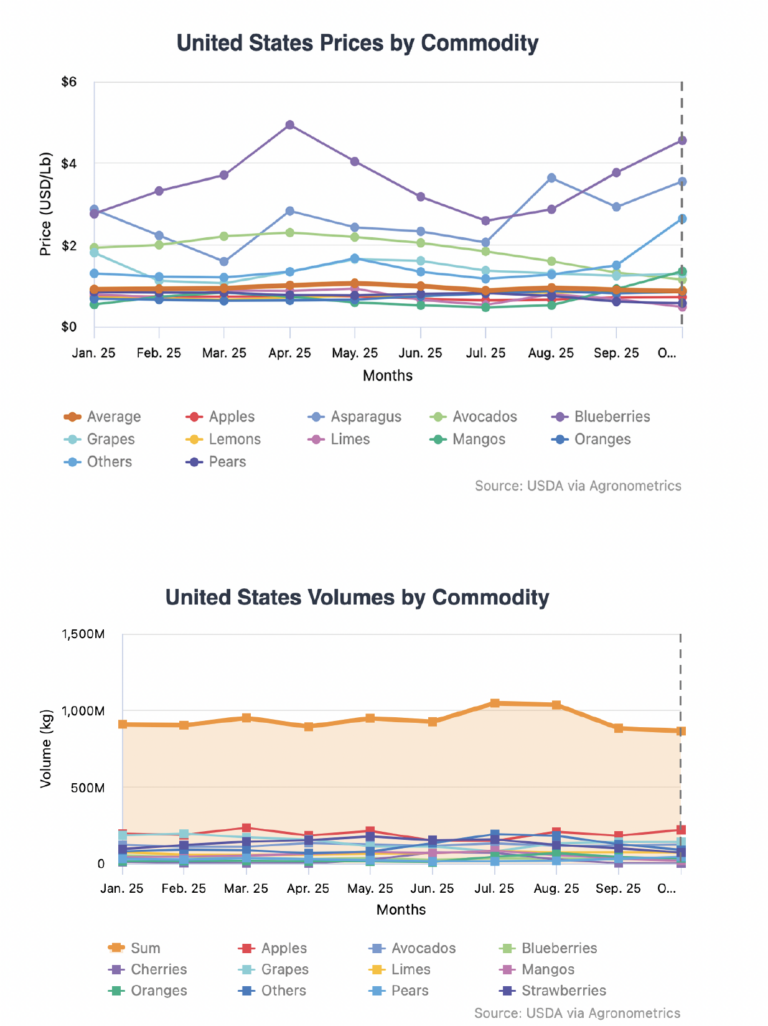
Together, these forces created a market where price movements were less erratic yet still responsive to seasonal shifts. Agronometrics data for September–October show how the market adjusted as the season progressed: many categories saw shipping point prices soften in early autumn, while others firmed due to reduced late-season availability or higher import costs.
Blueberry prices, for example, rose from $3.77/kg in September to $4.56/kg in October as late-season domestic supplies dwindled. Peru, which typically reaches its export peak in October, saw volumes plateau this season, tightening supply even as demand held steady. Despite the rise, October prices were still about 18.5% lower than a year earlier.
Blackberries followed a similar pattern, climbing from $2.61/kg in September to $3.43/kg in October as California and Mexican production transitioned. Even so, prices remained about 14% below October 2024 levels. Strawberries also firmed seasonally, up from $1.95/kg to $2.89/kg, while raspberries increased from $2.44/kg to $3.15/kg — still below 2024 figures.
Avocado prices fell to $1.15/kg in October, a 36% drop from 2024 amid persistent global oversupply. Mangoes, by contrast, strengthened to $1.35/kg as the market shifted between supplying origins.
At a broader level, the average shipping-point price dipped from $0.90/kg in September to $0.87/kg in October, mirroring typical autumn seasonality as summer-fruit premiums faded and higher-volume fall crops came online.
The market continues to face familiar pressures: erratic weather, labor shortages, and trade uncertainty. Year on year, overall fruit and vegetable prices rose by just 1.3% between September 2024 and September 2025, according to the Bureau of Labor Statistics — far less than in the preceding two years.
The trend underscores a clear moderation in price growth, even though overall levels remain higher than before the pandemic. The patterns seen in September and October confirm 2025 as a year of tempered market responses — more predictable than before, yet still shaped by global trade dynamics and the inherent sensitivity of fresh-produce supply chains.