


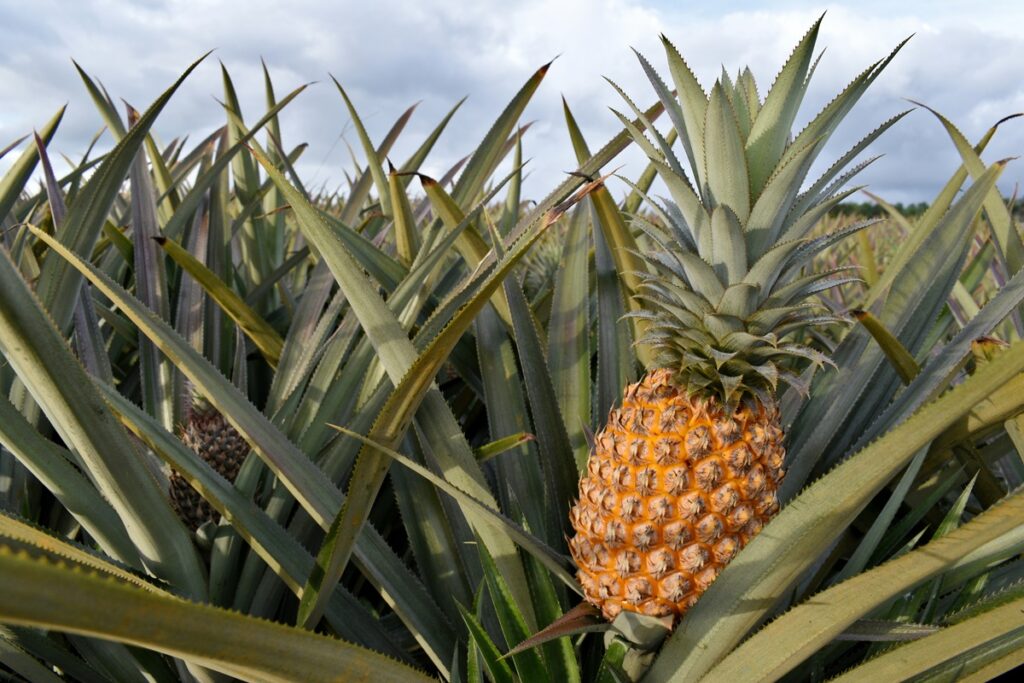


It was dark. Quiet. The kind of stillness that only deep night can bring. Surely everyone was in bed by now. If ever there was a time to act, it was now.
Slipping through the grounds of a wealthy Londoner’s estate, he made his way to the prized hothouse — a glass-domed temple of warmth and moisture that had once been under his care. Just months earlier, he had tended to its exotic treasures as gardener and caretaker. Now, he was an intruder. The instant he stepped inside, he was struck again by the heavy tropical air unlike the damp chill outside. One could easily think they had been transported to the Amazon, but this was no time to reminisce.
He moved quickly, navigating rows of rare plants by moonlight. He spotted his target, severing seven fruits from their stalks. Each was a prize. By morning, he sold them at Covent Garden for a hefty sum — but his success was short-lived. Tracked down by his former employer, he was arrested and sentenced to seven years in a penal colony. His crime? Stealing seven pineapples.
This seemingly petty theft was no small matter in 19th-century England, where pineapples were more than just fruit — they were status symbols worth a fortune. Reserved for the ultra-wealthy and royalty, the pineapple could make (or ruin) a man’s future. But how did this spiky tropical fruit come to hold such power in Britain’s social and political life? The story begins thousands of miles away, deep in the Amazon basin.
The Rise of the Pineapple
The wild pineapple plant is indigenous to the Paraná–Paraguay River drainage basin, an area that is now southern Brazil and Paraguay. The first people to domesticate it were the Tupí-Guaraní, who thrived along the Brazilian coast and in the riverine forests of the interior. They took the small, acidic, seed-filled wild variety and transformed it into the sweet, fleshy fruit we know today. For them, it was more than just food — it was a symbol of excellence. Their word for it, nanas, meaning “excellent fruit” or “fragrance,” would be adopted in languages around the world.
By the time Columbus returned to the Americas in 1493, the pineapple was already widespread across indigenous territories. One of his companions, Michele de Cuneo, made note of this impressive fruit in a letter to his friend: “There are also some like artichoke plants but four times as tall, which give a fruit in the shape of a pine cone, twice as big, which fruit is excellent and it can be cut with a knife like a turnip and it seems to be very wholesome.”
Columbus returned to Spain bearing gifts for King Ferdinand and Queen Isabella, including birds, instruments, and several pineapples — though only one survived the voyage. Eager to present it before it spoiled, Columbus rushed to the castle. The King and Queen tasted the fruit and were delighted. With their endorsement, the pineapple’s reputation began to spread rapidly.
Soon, European explorers were obsessed. Gonzalo Fernández de Oviedo y Valdés, a Spanish chronicler, devoted six full pages to describing the fruit in his Historia General y Natural de las Indias, and still felt he hadn’t captured its majesty. As pineapple fever spread, so too did the physical spread of the plant. Just over 100 years after being discovered by Europeans, the pineapple was being grown in tropical areas all around the world.
The pineapple found its way to the west and east coasts of Africa thanks to the Portuguese, to South Africa thanks to the Dutch, and to the west coast of India thanks again to the Portuguese. In fact, the pineapple did so well in India that the Mughal Emperor Jahangir had thousands of pineapple plants grown in the palace gardens at Agra. To this day, the pineapple is one of India’s most commonplace fruits.
A Fruit Fit for a King
Despite its global spread, the pineapple remained rare in Europe and still firmly a fruit of kings. Nowhere was this more vividly illustrated than in Restoration England, under the rule of King Charles II.
At the time, English merchants seeking royal favor had but one formal avenue: the petition. These petitions, however, were rarely submitted without gifts — lavish tokens meant to catch the King’s eye and sweeten the request. Silver, silks, and spices were common fare. But in August of 1661, a group of merchants from Barbados took a bold and unusual step. Hoping to secure more favorable terms in the sugar trade, they presented the King with something far more exotic: a pineapple.
It was a gamble, but a well-calculated one. Charles II was famously enamored with all things rare and curious, particularly fruits and plants from distant lands. The pineapple, strange in shape and intoxicating in scent, immediately captivated him. The merchants got what they came for. And Charles? He gained more than some fruit. He gained a symbol.
In 1668, as tensions with France flared over Caribbean territories, Charles II hosted a banquet for the French ambassador. At dessert, a grand fruit display appeared, crowned with a single pineapple — the first seen publicly in England. It sent a clear signal: England had access to rare New World treasures. To reinforce the image, Charles later commissioned a portrait of himself being presented with the fruit by his gardener — a staged display of imperial clout.
The pineapple had arrived in England not just as a delicacy, but as an emblem of status, ambition, and rising geopolitical clout.
Growing Gold
As with all royal fascinations, it wasn’t long before England’s nobility sought to imitate the King’s taste for pineapples, hoping to elevate their own social standing by association. But acquiring these rare fruits was no easy feat. Sourced from thousands of miles away, pineapples were difficult to transport, wildly expensive, and prone to spoilage. For ambitious aristocrats, the solution was clear: if they couldn’t reliably import pineapples, they would find a way to grow them at home – even in the cold, damp climate of Britain.
Greenhouses were already in use across Europe to shelter citrus trees from harsh winters. But the pineapple posed a greater challenge. It didn’t just need protection from the cold – it required consistent heat and sunlight, year-round.

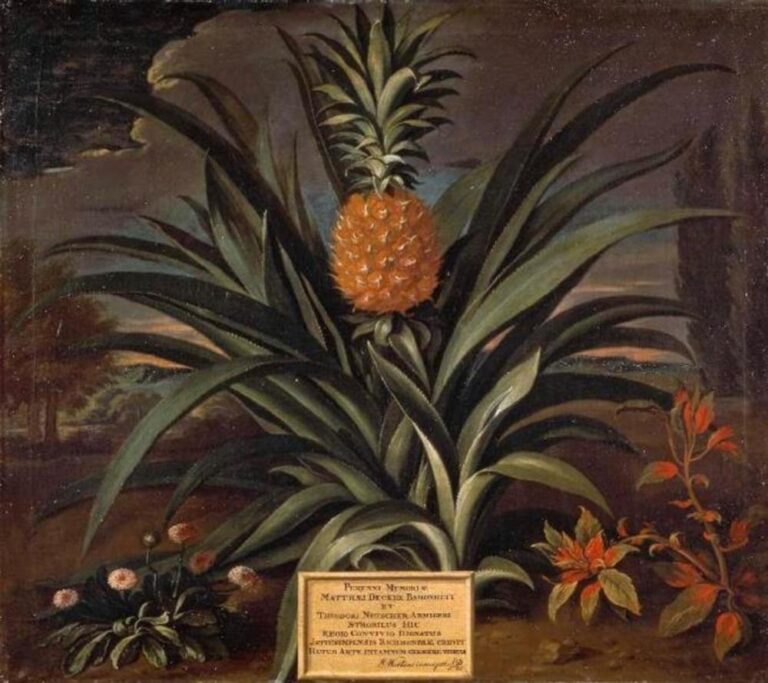
Dutch gardeners were the first to solve the pineapple problem in the 17th century. Pieter de la Court’s gardener discovered that tanner’s bark, used in leather production, could generate sustained heat as it decomposed.
This technique soon reached England, where Sir Matthew Decker used it to grow the first pineapple on English soil — and proudly celebrated the feat with a commissioned painting.
With this new technology in hand, pineapple greenhouses (or “pineries”) soon became all the rage among England’s aristocracy.
Growing a pineapple was a slow, labor-intensive process. It could take two to three years to produce a single fruit, and the cost of maintaining a pinery meant that even homegrown pineapples remained prohibitively expensive. A single specimen could fetch £80 at the time — the equivalent of around £5,000 today. Little wonder, then, that some were willing to steal them, as we heard at the beginning of this article.
At grand dinner parties, pineapples became the ultimate centerpiece — a symbol of taste, wealth, and refinement. In fact, so prized were they that a single fruit might be passed from one banquet to another, long past its prime, until it finally began to rot.
From Luxury to Lifestyle
By the mid-18th century, Britain was booming. An expanding empire had ushered in an era of economic growth, and with it came a significant social shift: the rise of the middle class. As wealth trickled down beyond the aristocracy, previously exclusive luxuries — like tea and sugar — began appearing in middle-class households.
Fresh pineapples, however, remained out of reach for most. But that didn’t stop people from indulging in the next best thing: pineapple-themed merchandise. Suddenly, symbols of the once-royal fruit were everywhere — from chinaware and tea caddies to gateposts and centerpieces, all used to signal taste and social aspiration.
The obsession crossed the Atlantic too. In the American colonies, figures like George Washington and Thomas Jefferson embraced the pineapple as a symbol of refinement and hospitality. Washington reportedly counted it among his favorite fruits. Unlike in Britain, however, American elites didn’t grow pineapples themselves. Instead, they benefited from easier access to Caribbean imports.
Back in Britain, the Industrial Revolution accelerated everything. As trade routes expanded and steamships sped up delivery, the pineapple began to lose some of its exclusivity. By 1850, some 200,000 pineapples were arriving at London’s docks each year. While the highest-quality fruits still graced the shelves of luxury fruiterers, the less desirable specimens were offloaded onto the carts of costermongers — the street hawkers of Victorian London — who sold them to passersby for as little as sixpence.
And then came refrigeration. By the late 19th century, with cold storage revolutionizing food distribution, the era of the homegrown pineapple — once the proud possession of kings and aristocrats — was effectively over. The pineapple had completed its transformation: from royal rarity to everyday indulgence.
Canning the Pineapple
On the American front, in the mid-19th century, pineapples were being grown in abundance across Florida and California. But geography posed a major hurdle. The fruit had to travel vast distances to reach major markets, and without refrigerated transport, pineapples often arrived bruised, flavorless, or worse — rotten. For regions beyond the reach of the expanding railroad network, pineapples remained prohibitively expensive.
Then came a breakthrough: canning. In 1893, the invention of the Lewis Pineapple Peeling Machine revolutionized pineapple processing. This machine could core, slice, and peel pineapples at a rate of four per minute, making mass production not just possible, but profitable. Seizing the opportunity, Englishman John Kidwell set out to establish Hawaii’s first pineapple cannery. Though pineapples weren’t native to the islands, many believed the climate in Hawaii produced the sweetest, most flavorful fruit anywhere in the world.
But there was one major obstacle: tariffs. At the time, Hawaii was still an independent kingdom, and all processed food products shipped to the U.S. mainland faced a steep 35% import tax. Kidwell’s operation couldn’t compete. However, that all changed just five years later.
In 1898, Hawaii became a territory of the United States. Suddenly tariffs were lifted and a whole new American market opened. Unfortunately for Kidwell, he had already abandoned the pineapple business but in 1899 a new man, at just 24 years of age, stepped up to develop the pineapple business: James Drummond Dole. In 1900, he purchased 61 acres of land in Wahiawa and planted 75,000 pineapple plants. With his modest savings, he acquired machinery for slicing and canning, and by 1902 had founded the Hawaiian Pineapple Company — later renamed the Dole Corporation.

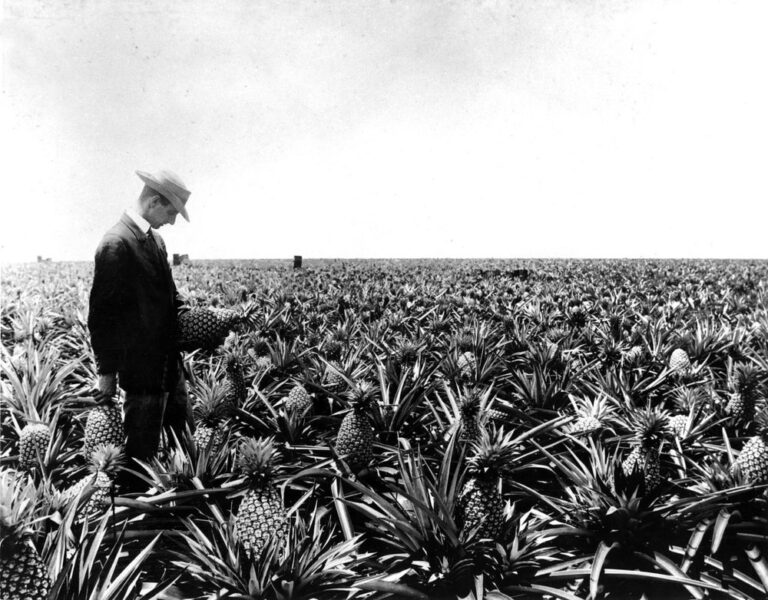
From that point on, the story of the pineapple was inseparable from the story of American capitalism. By 1940, Hawaii had become the world’s leading supplier of canned pineapple, producing nearly 70% of the global supply. In fact, during both World Wars, canned pineapple was shipped in vast quantities to feed the armed forces.
After the war, demand continued to grow. But so did challenges. Mealybug infestations in Hawaiian plantations and rising labor costs prompted producers to look abroad. New canneries were established in places like the Philippines and Thailand. By 1974, Thailand had surpassed Hawaii to become the world’s top pineapple producer. By the year 2000, Hawaii’s share of the global market had shrunk to a mere 2%.
The Gold Rush
For much of the 20th century, canned pineapple dominated the global market and remained the pineapple industry’s primary source of income. But everything changed in the 1990s with the arrival of a new star: the MD-2 pineapple.
Developed in the 1970s through a cross between two earlier hybrids bred in 1958 and 1959, the MD-2 was a game-changer. It was significantly sweeter, less acidic, and less fibrous than its predecessor. Most importantly for consumers, its flesh ripened to a vibrant golden yellow — matched by its shell — making it far easier to tell when the fruit was ready to eat. This was a sharp contrast to the then-dominant Smooth Cayenne variety, whose dull green skin often remained unchanged even when perfectly ripe.
In the early 1990s Fresh Del Monte moved to secure rights to MD‑2. When joint applications fell through due to co-owners withholding consent, Fresh Del Monte filed its own patents — one for MD‑2’s genetic traits and another for a related hybrid called CO‑2 (marketed as ‘Del Monte Gold’).
In 1996, Fresh Del Monte launched its own branded version of the MD-2: the Del Monte Gold. It was an instant sensation. After decades without a new pineapple variety, consumers were eager for something fresh, and Del Monte Gold delivered. Within months, it quickly became the world’s most popular fresh pineapple, capturing a large share of global trade. Demand far outpaced supply.
That shortage reportedly led to competing companies poaching Fresh Del Monte’s field workers to extract growing secrets. According to some reports, rivals even flew to the United States just to buy boxes of Del Monte Gold pineapples from supermarkets — discarding all but the leafy crowns, which they smuggled back to Costa Rica for propagation.
Eventually, Dole — arguably Fresh Del Monte’s biggest competitor — secured the prized genetic material. In 1999, it established a pineapple plantation in Honduras and launched its own version of the MD-2: the Dole Premium Select.
Fresh Del Monte responded with a lawsuit, accusing Dole of misappropriating trade secrets related to the MD‑2 pineapple. In 2001, a U.S. court recognized that genetic material and growing techniques can qualify for protection under trade secret law, even if the plant material itself is publicly available. The case was settled before trial. As part of the settlement, Dole paid $1.5 million and agreed to certain restrictions related to the MD‑2 planting material. Dole has since continued to grow its share of the fresh pineapple market.
Return of the Royal Fruit?
In more recent times, Fresh Del Monte has launched the Pinkglow pineapple — a rosy-hued fruit that recalls the days when pineapples were the crown jewels of the aristocracy. While online it typically sells for $29 plus shipping, retail prices vary, with the most common format sold at around $14.99.
So, are we returning to a new pineapple aristocracy?
Perhaps. But while the pineapple may no longer dictate foreign policy or decorate kings’ tables, its journey from the jungles of South America to Covent Garden’s market stalls, from royal dessert to canned commodity, remains one of the most remarkable tales in the history of fresh produce.
And for one London gardener, it was a tale worth risking everything — even exile in Australia.