


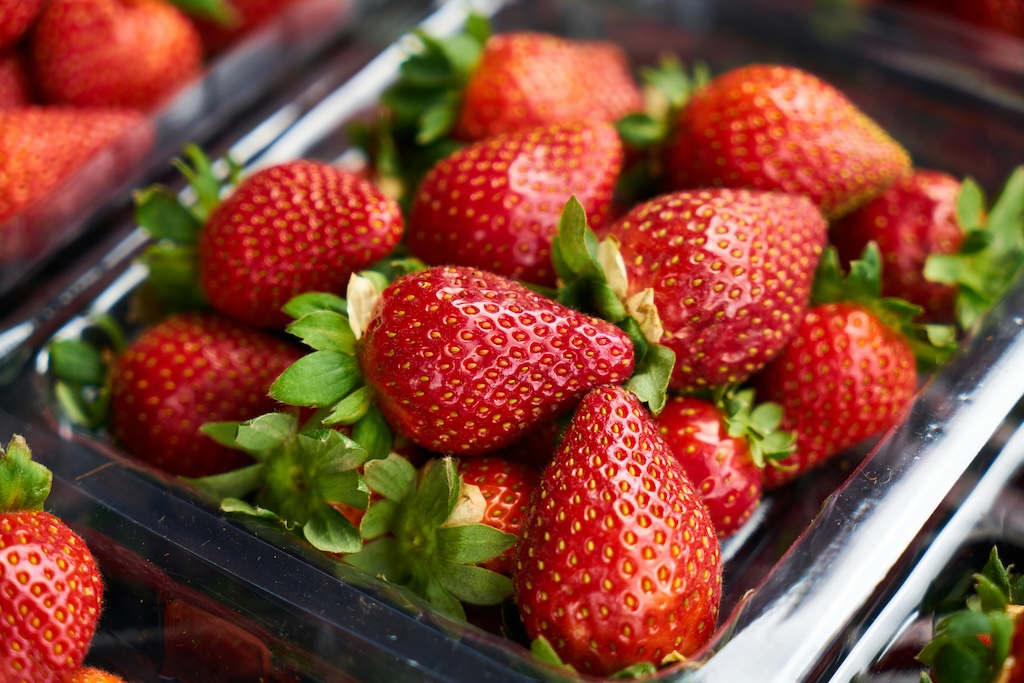


Step into any modern supermarket and you enter a landscape of dazzling abundance. Berries glistening under bright lights, bouquets of flowers standing tall, apples stacked in perfect symmetry. But look closer, and a paradox appears. Those berries sit in rigid plastic clamshells, the flowers are swaddled in cellophane, and the apples gleam with an almost otherworldly polish. These are nature’s most elemental offerings, yet the way we buy them seems anything but natural.
Plastic and produce: two things that once seemed worlds apart. Fruits and vegetables are the essence of the earth — grown in fields, harvested from trees, pulled from soil. Plastic is a feat of modern alchemy, spun from oil and gas in the laboratories of the 20th century. And yet, over time, the two became bound together.
So how did this unlikely union take shape? And what legacy has it left us today?
The Birth of Plastic
The story of plastic and produce begins, curiously enough, not in a grocery aisle but on the billiard table. In the 1860s, billiard balls were carved from ivory, but with elephant populations dwindling, supply was running out. This inspired American inventor John Wesley Hyatt to develop celluloid, an early “plastic” made from nitrocellulose and camphor. Like any invention, it wasn’t perfect. One Colorado saloon keeper swore Hyatt’s balls occasionally exploded on impact like shotgun blasts, but it opened the door to a new material age.
The real breakthrough came in 1907, when Belgian chemist Leo Baekeland, working in his New York laboratory, produced Bakelite. Unlike celluloid, Bakelite didn’t just imitate natural materials — it was something new altogether. Durable, moldable, resistant to heat, and made from the waste products of coal, it was hailed as a miracle material. Radios, telephones, and electrical insulators all soon bore the mark of Baekeland’s invention.
Then, in 1908, plastics quietly edged closer to the dinner table. A Swiss chemist invented cellophane, spun not from coal but from cellulose, originally to make waterproof fabric. When American chemicals giant DuPont acquired the rights in the 1920s, it spotted its true potential: food. Transparent, glossy, and air-resistant, it allowed shoppers to see what they were buying while keeping products fresh. By the 1930s, American grocers were experimenting with wrapping fruits and vegetables in this miraculous new film. The results were promising. Tomatoes stayed bright, lettuces crisp, and customers delighted in food that looked not only fresh but clean.
Plastics Go to War
Then came the Second World War, the great accelerator of the plastic age. With metals reserved for tanks and guns, glass too fragile for combat, and natural resources stretched thin, corporations turned to plastics. Nylon replaced silk in parachutes. Plexiglass stood in for glass in aircraft canopies. Even the Manhattan Project relied on Teflon’s chemical resistance to contain volatile gases.
The shift towards this new miracle material was staggering. In 1939, the United States produced 213 million pounds of plastic. By 1945, that figure had soared to 818 million. What had once been a scientific novelty had become a cornerstone of the war machine.
Out of this crucible rose new industrial giants. DuPont, Dow, and Union Carbide emerged from the conflict as titans of chemistry, with vast research arms and deep pockets. But when the war ended, they faced a problem: what to do with their new materials and their new factories? The answer lay in consumer markets. More specifically, the supermarket.
The Plastic Supermarket
The post-war years saw the rise of a new shopping concept: the self-service grocery stores, those temples of convenience that would soon become supermarkets. Here, plastic found its natural home. Loose apples were easily bruised by careless hands; lettuce wilted on the shelves; berries squashed in transit. Plastic promised protection, hygiene, and longer shelf life.
Even before the war ended, its potential had been tested. In 1944, an initiative in Columbus, OH, brought together grocery executives, packaging firms, and refrigeration companies to trial prepackaged fruits and vegetables. Produce was wrapped in cellophane, stamped with labels and prices, and chilled until delivery to self-service stores. The results were astonishing. Losses dropped from nearly 30% to almost nothing. Labor costs shrank. Shelf life improved. And, most importantly, customers embraced the ease of picking up ready-packed goods.
Although the so-called Columbus Experiment did not single-handedly invent the modern supermarket, it did show how plastic and refrigeration could make the self-service model viable. No longer did shoppers have to wait at a counter for a grocer to measure out potatoes or pluck strawberries by hand. Shoppers now roamed aisles freely, filling their carts. Transparent wrapping invited them to inspect, compare, and, inevitably, buy more.
By the 1950s and 60s, the supermarket era was in full swing. Tomatoes came in plastic tubes and strawberries in pulp baskets wrapped in cling film. For grocers, plastics promised efficiency, lower waste, and higher turnover. For shoppers, they promised modernity and cleanliness.
Plastic and produce had become not just a partnership, but a marketing triumph. And the story was only beginning.
The Clamshell Revolution
Over the next two decades, a variety of plastic packaging concepts hit the shelves. But if there was one single package that defined the plastic age of produce, it was the clamshell.
In the early 1980s, Driscoll’s, the California-based berry giant, began experimenting with replacing its traditional green pulp baskets. They eventually introduced a clear, rigid, vented plastic box with a hinged lid. Simple though it looked, the design solved a host of problems. Berries could now be shipped long distances without bruising, displayed without spilling, and sold in uniform portions.
The effect was revolutionary. Suddenly, strawberries were no longer a fleeting June pleasure. Thanks to clamshells (and refrigeration, of course), they could be picked in southern California, shipped across the country, and bought in January in Chicago or Boston. The ancient rhythm of seasonality, which had governed fruit for millennia, was swept away. Growers now had access to new markets and consumers began to realize their dream of year-round access to their favorite fruits and vegetables.
But with abundance came dependency. Once retailers and growers realized what clamshells made possible, there was no going back.
Growers outside the berry world watched with interest. How might they harness plastic for their own crops? For leafy greens, the breakthrough came with modified atmosphere packaging. By the 1980s, bags of lettuce and spinach were being filled with carefully balanced gases, slowing spoilage and extending freshness for weeks.
The result was the bagged salad, one of the great symbols of the late 20th-century convenience culture. No washing, no chopping. Just open the bag, dump it into a bowl, and you have a salad. It was modern life in a nutshell: quick, clean, efficient and wrapped in plastic.
The Double-Edged Sword
Yet plastic’s triumph was also its curse. Its benefits were obvious: it reduced waste, extended shelf life, cut costs, and democratized access to once-luxury foods. Without plastic, industrial agriculture as we know it would collapse. Plasticulture — the use of films, mulches, irrigation tubes, seed coatings, and greenhouse liners — is woven into every corner of modern farming.
But the costs are impossible to ignore. According to the UN’s Food and Agriculture Organization, in 2019, agriculture consumed 12.5 million tons of plastic in production and another 37.3 million tons in packaging. Most of it was single-use and unrecycled. Too much of it now lingers in landfills, incinerators, or worse, scattered across fields and oceans.
Microplastics, scientists warn, are infiltrating soils, altering microbial life, disrupting water absorption, and even entering plant roots. They move up the food chain into fish, livestock, and ultimately, us. In recent years, studies have detected microplastics in human blood. The very material that makes food safe and plentiful may, ironically, be undermining the soil and systems on which that food depends.
Innovation Continues
But the story doesn’t end in despair. If history shows anything, it’s that the food industry is endlessly inventive.
Reusable plastic crates (RPCs) have replaced wooden boxes, lighter and more durable, though still plastic. Some supermarkets in Europe have experimented with “plastic-free” aisles, offering produce wrapped in paper, or none at all. Researchers are developing edible, plant-based coatings that mimic plastic’s protective qualities without the waste. And there is a growing movement back toward bulk bins and loose produce, closer to the way our grandparents shopped.
Will these efforts be enough? The odds are daunting. Plastic is cheap, effective, and deeply embedded in global supply chains. Packaging alone makes up nearly two-thirds of U.S. plastic waste. To undo that is to rethink not only how we shop but how we farm, transport, and eat.
And here history offers a warning. Plastic was not forced on us; it was embraced. Shoppers liked the shine, the cleanliness, the ease of tossing a wrapped head of lettuce into the cart. Retailers liked the lower waste and higher margins. Corporations liked the vast new markets. Plastic succeeded not because it was imposed, but because it fit so well with the rhythms of modern life.
A Plastic Legacy
To walk through today’s produce aisle is to see the legacy of a century of invention and compromise. What began as a handful of chemical experiments has reshaped not only how food is sold, but how we think about freshness, abundance, and even beauty. The gleam of a cucumber, the symmetry of grapes, the tidy portion of spinach — all of it carries the hidden fingerprints of plastic.
And yet, the very ordinariness of it all is striking. Few shoppers pause to imagine the armies of chemists, engineers, and marketers who made this version of “fresh” possible. Fewer still consider how deeply packaging has influenced diets, shopping habits, or the global reach of agriculture. Plastic didn’t just preserve produce; it transformed expectations of what produce should be.
But history rarely moves in straight lines. Just as ivory gave way to celluloid, and paper sacks yielded to polyethylene, so too the present might give way to something else. The current unease about plastic waste may mark not the end of abundance, but the beginning of another reinvention. Tomorrow’s shopper could find a supermarket that looks familiar yet functions entirely differently, with new materials, new systems, and new ideas of what “freshness” means.
Plastic bound produce to modernity, for better and for worse. Its future role, however, remains unwritten. It’s a reminder that the history of something as simple as a bag of grapes is never truly finished.
- John Paap is the Sustainability and Brand Marketing Manager at Jac. Vandenberg, Inc. and co-host of “The History of Fresh Produce” podcast series on The Produce Industry Network.