


Coming soon to a stack of pancakes, a smoothie or a muffin near you: The tech-enabled, data-informed blueberry. For the nearly $9.1 billion impact the blueberry industry has on the U.S. economy, this is more than a clever phrase. It’s a roadmap for how our sector can stay resilient and capture more value for the entire supply chain.
From where we sit — one of us representing growers, marketers and key industry stakeholders, the other building data solutions for specialty crops — we’re convinced of one thing: If technology is going to work for growers, it has to start in their fields, under their pressures and on their terms, not in a slide deck.
That conviction was the impetus for the BerrySmart Field program, sponsored by the U.S. Highbush Blueberry Council (USHBC) and implemented by innov8.ag (a Walla Walla, Washington-based ag-tech company founded in 2019 by former Microsoft executive Steve Mantle), to build a new kind of “smart farm network,” connecting university research, cutting-edge technology and daily field realities directly to margin outcomes across the supply chain.
Why Blueberries Need a Different Innovation Model
Blueberry growers have never lacked for innovation. But today’s wave of tools — sensors, imagery, automation, AI and advanced analytics — is arriving faster and with far more complexity than most growers can reasonably absorb, especially as they are being asked to do more with less.
Our goal with the BerrySmart Field program is to take that complexity off their plate by vetting solutions and connecting growers with tools, training and insights that can actually work, from the field to the retail shelf.
In blueberries, there has been a lot of innovation after the fruit leaves the farm, but surprisingly little quantifiability about what is actually going on in the field. With BerrySmart, we are validating a smart farm network that connects what happens in the soil and canopy to the margin outcomes at the shed, the marketer and the customer, so growers, packers and marketers can all act with more confidence.
A “Crawl, Walk, Run” Path Instead of Leap‑and‑Hope
As Washington grower and USHBC BerrySmart Technology Task Force Chair Noel Sakuma, who has helped shape the program from the beginning, reminds us, “You can’t just drop a robot in the field, call it innovation and walk away.”
Yet, too often, innovation in specialty crop production has been sold on the “leap of faith” model. It’s not working. To change the dynamic, the BerrySmart Field program has implemented a “crawl, walk, run” approach, designed to reduce the risks of innovation for growers and for the tech providers who serve them.
Crawl: Establish baselines and validate that sensors, imagery and analytics perform reliably in commercial blueberry fields, not just controlled trials.
Walk: Use those insights to make targeted adjustments in irrigation, nutrition, pruning, pollination and harvest planning, then measure what actually moves the needle.
Run: Scale successful practices and tech stacks across farms and regions, while refining decision-support tools.
From our vantage point, this structure is just as critical as the innovation itself. When everybody understands we’re crawling first — validating sensor accuracy, making sure maps reflect reality, ground‑truthing the data that everything flows through — it builds trust and better outcomes. Only then does it make sense to walk and run together, with less risk and far more clarity about what success looks like.
Turning Test Farms Into Real-World Labs
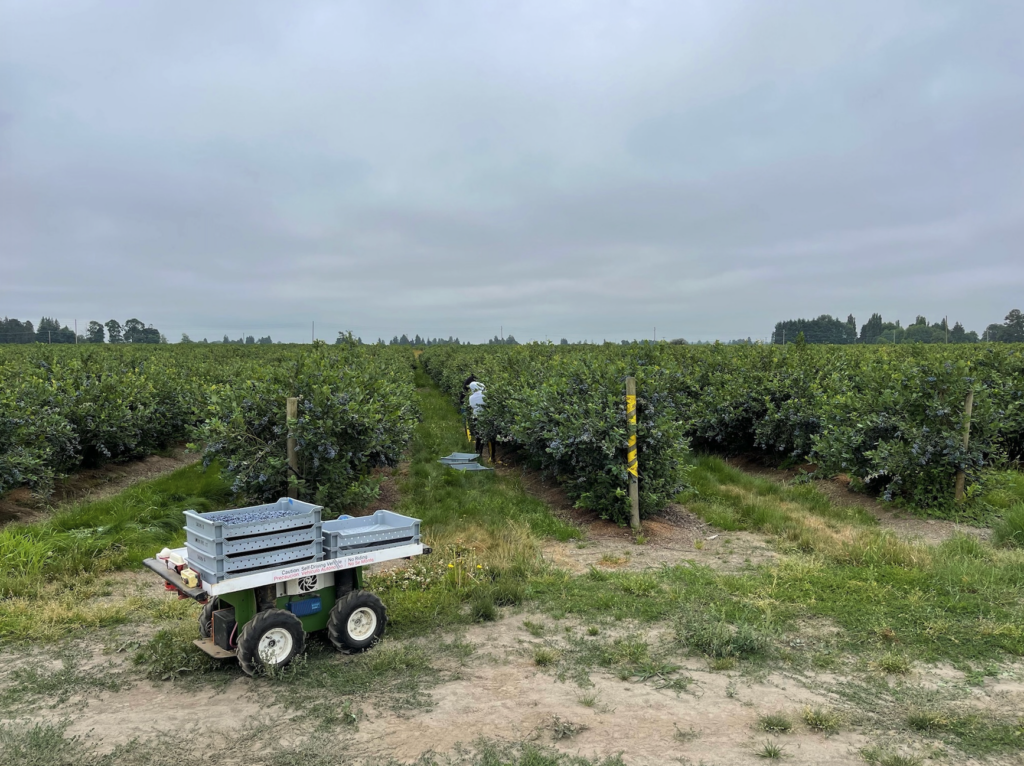
If we want technology to work for growers, we have to test it where growers actually farm: in dust, rain, heat and the harvest crunch. That’s why BerrySmart Field is anchored in pilot farms in Oregon, Washington and, most recently, New Jersey and Florida, which operate as living labs for real‑world evaluation.
On these farms, tools such as high-resolution soil mapping, blossom and fruit imaging, autonomous carts and AI‑assisted yield forecasting are deployed under commercial conditions and pushed to their limits, giving us a place to push tools hard, fail fast when needed, and refine what actually works before we ask the wider industry to invest.
The annual BerrySmart Field Days held at these sites are where that learning is translated into practical insight for growers, marketers and researchers. Co‑hosted with partners including Washington State University, Oregon State University, University of Florida, and Rutgers University, these events have already brought hundreds of stakeholders into the field to see side‑by‑side comparisons, ask hard questions and engage directly with the data.
Yield Estimation: The Proving Ground for “Better Insight”
A good example of what strides the BerrySmart Fields program is making is our work in fine-tuning blueberry crop yield estimation, a priority for the industry.
New Jersey grower and past USHBC Council member Paul Macrie III puts it bluntly: “Growers don’t need more data — they need better insight. Prioritizing yield estimation was an obvious choice to prioritize because it’s a variable growers lean on to make almost every other decision. When it’s right, it can mean the difference between a profitable year and a missed opportunity; when it’s wrong, it can undermine everything from labor planning to customer relationships.”
To improve yield estimates, we’ve been leading two complementary, data‑focused efforts under the BerrySmart banner through Innov8.ag and our partners.
We’re working with industry partners using AI and satellite imagery to identify blueberry acreage by farm, county, state, region and eventually country. We’ve been quantifying the timing of harvest for early-, mid- and late-season acreage, and defined how weather and planting year affect yield. Then we’ve been combining crop mapping with AI to tune ripening curves for widely planted varietals and built on a multi‑year database spanning more than 45 varieties, 1.97 billion blueberries counted, 432 million images analyzed and forecasts for more than 79,000 hectares of crops.
The result? We’re moving from gut feel and block‑level averages to row‑by‑row, plant‑by‑plant insight that combines historical, across-the-country data with real‑world “what’s happening now” actionability that gives growers the data they need to plan labor, logistics and even marketing with a level of precision that simply was not possible before.
What’s at Stake for the Blueberry Value Chain
Now starting in our fifth season, BerrySmart Field has reached an inflection point where it can deliver tangible outcomes, including improved yield visibility earlier in the season, greater consistency in data collection across farms and regions, and increased confidence in technology adoption.
As we look ahead, our vision is clear: a connected, data‑driven blueberry sector where growers and marketers can manage complexity with greater precision, and where technology delivers not just more data, but more profitable decisions for everyone who depends on blueberries — from the field crew to the family at the dining table.
- Amanda Griffin is the Vice President of Engagement and Education, U.S. Highbush Blueberry Council and North American Blueberry Council, and Steve Mantle is the Founder and CEO of innov8.ag.