


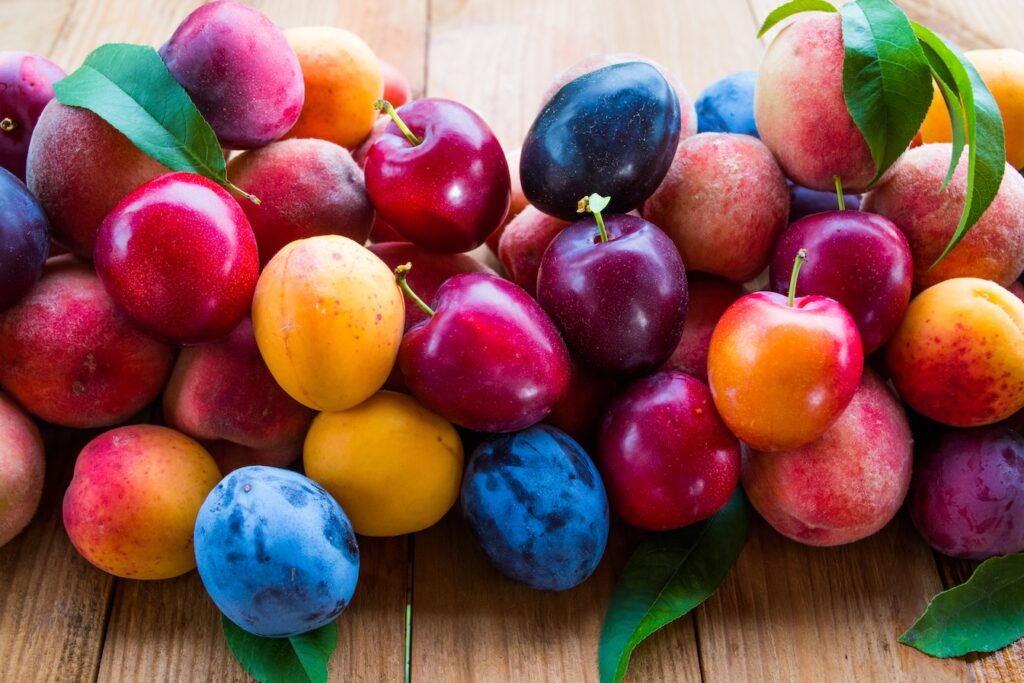


Few fresh produce categories are as closely tied to seasonality as stonefruit. Peaches, nectarines, plums, apricots, and cherries arrive in a relatively tight window each year, creating a sense of anticipation that retailers and consumers alike recognize.
Unlike year-round fruit categories, stonefruit performance depends especially heavily on timing, eating quality, and presentation. When conditions align, the category can deliver strong movement and high consumer satisfaction, particularly during peak summer weeks when flavor and aroma are at their best.
Stonefruit is also defined by its diversity and sensory appeal. Differences in flesh color, acidity, texture, and aroma allow retailers to merchandise a wide range of options within a single category, from low-acid, sweet varieties to more tangy, aromatic fruit.
That range supports both impulse purchases and repeat buying, especially when shoppers are able to compare varieties side by side. The category also includes a growing number of hybrid fruits, such as plum-apricot crosses, which add further interest and expand consumer choice.
Beyond fresh eating, stonefruit benefits from broad culinary versatility. Its firm structure and balanced flavor profile make it suitable for both fresh consumption and cooking, including grilling, baking, and pairing with savory dishes.
Flavor remains the primary driver of repeat purchases, making quality at harvest and careful handling throughout the supply chain essential. Unlike categories where availability is a key selling point, stonefruit rewards precision. When fruit is harvested at the right maturity and delivered at peak condition, the category is well positioned to meet consumer expectations and perform strongly at retail.
In the U.S., stonefruit production is concentrated in a handful of regions, each with a distinct role in the category. The Pacific Northwest is widely regarded as the country’s primary sweet cherry growing area, supplying both domestic and export markets during the summer season.
In the Southeast, Georgia remains a key peach-producing state and is closely associated with the crop’s identity, supplying early-season fruit and holding strong recognition with consumers. South Carolina also plays a meaningful role in early peach production, helping extend the seasonal availability ahead of Western harvests.
California Remains the Backbone of U.S. Stonefruit Volumes
Together, these regions help structure the U.S. stonefruit calendar, with California providing the volume backbone once peak summer demand arrives.
Speaking in December, Daniel Hartwig, president of the California Fresh Fruit Association (CFFA), said that overall volumes from the state in the 2025 season came in slightly below the prior year.
“The 2025 season was a little short of the 2024 crop due to various weather and climatic conditions. Some varieties were impacted by unexpected summer rains,” he said. It was still too early to give forecasts as to the 2026 season.
Beyond annual crop size, longer-term structural changes continue to shape the industry. Labor availability remains a central concern, prompting growers to explore practical adjustments in orchard design and field operations.
“Growers are trying new techniques in the fields to adapt to California’s labor challenge,” noted Hartwig. “Some are adapting new trellising techniques, some are changing the shape of the trees so that the fruit can be more easily harvested with adopted technology, and folks have their eyes on what might be accomplished with the use of artificial intelligence — though the use of this technology so far remains elusive in the fields.”
Export markets also remain an important part of the picture, though not without complications.
“We have been seeing challenges in export markets with regards to reciprocal tariffs and non-tariff barriers. Some of these are issues that have been going on for many years,” he said.
At the same time, growers continue to manage a wide range of cost pressures and regulatory demands.
“The industry has its eyes on many issues. Making sure that there is a stable workforce available is always critical. The costs of doing business in California with wages increasing year over year. Insurance costs are increasing and insurers are not always willing to renew policies,” said Hartwig.
“Energy costs are increasing much faster than inflation. Making sure that there is sufficient water available long-term with new regulations in that space. Growers are working their tails off to deliver the best-tasting fruit in the world every year, while also keeping one eye firmly looking at the future.”
USDA Report Shows Global Supplies Fall for First Time in Years
Providing a global perspective on volumes, a USDA report on the 2025-26 marketing year published in September 2025, revealed that global fresh cherry production was forecast to fall more than 10% to 4.6 million tons. It said that this reduction came as smaller crops in Turkey, the European Union, and the United States more than offset increased production in China and Chile.
“If realized, this would be the first decline in global production in six years,” the report stated. “U.S. production is forecast down 18,000 tons to 403,000 tons, mainly due to smaller cherry crops in California and Michigan. EU production is forecast down 118,000 tons to 644,000 as spring frosts in Poland, Greece, and Italy more than offset a larger crop in Spain.”
Meanwhile, global fresh peach and nectarine production is also forecast down. The USDA anticipates it will fall by 6% to 23.8 million tons on expected smaller crops from the top four producers.
If realized, it says, this would be the first decline in global production in five years.
“China production is projected to fall 600,000 tons to 17.0 million due to drought and a spring frost in major growing regions,” the report stated.
“EU production is forecast down nearly 10% to 3.1 million tons on hail damage in top producer Spain and a spring frost in Greece. Turkey and U.S. production are also forecast down year-over-year.”