
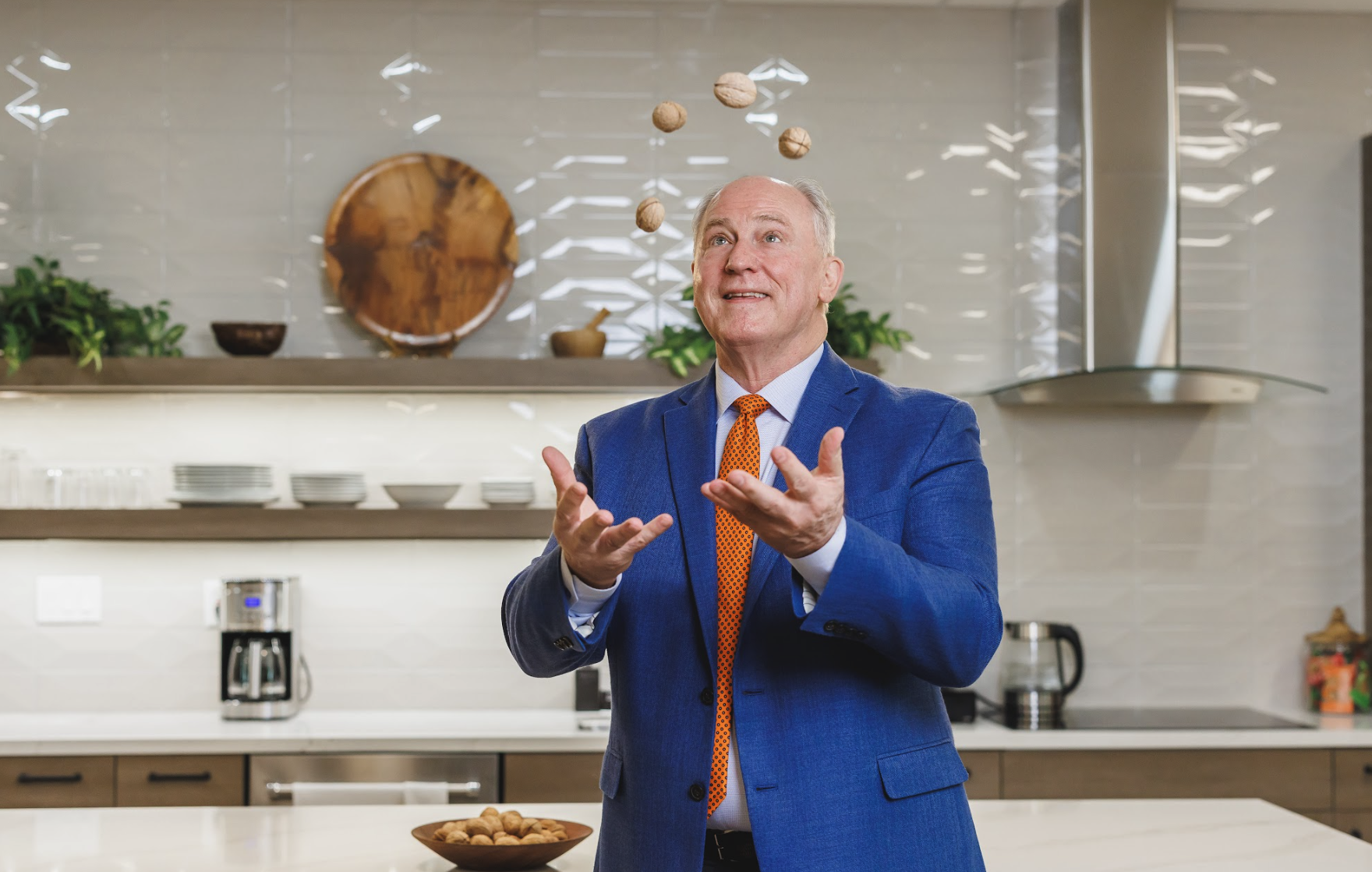
For Robert Verloop, the route to the California walnut industry began long before he became executive director and CEO of the California Walnut Board and Commission in July 2022. It began in a small neighborhood produce store in the Netherlands, owned by his parents and where produce was part of daily life. Nuts were always on the table, potatoes and French fries were staples, and his father took pride in cracking walnuts so cleanly that the kernel stayed whole. “So when I say produce is in my blood, I really mean it,” says Verloop.
That early connection has followed him across a career spanning citrus, avocados, berries, vegetables and now walnuts. After moving to the U.S. as a child and settling in Southern California, Verloop studied plant science at Cal Poly Pomona, with a focus on citrus and avocado production, before earning a master’s degree in agricultural science. He later worked internationally, including with USAID on citrus and tropical fruit research in Yemen and with Pandol Bros. in northeast Brazil. His later roles included leadership positions with the California Avocado Commission, Sunkist Growers, Naturipe Farms and Coastline Family Farms.
Verloop does not see walnuts as an outlier from produce, but as part of it. When he told one industry contact he was moving into walnuts, the response was: “Man, we’re sorry to see you leave produce.” Verloop’s answer has since become a kind of shorthand for his approach: “What do you mean? Walnuts are produce, too.”
In his view, the challenge is not only to sell more walnuts, but to change how the category is understood. In the U.S., he says, walnuts are still too often seen as a baking ingredient, such as in “grandmother’s banana nut bread,” rather than a fresh, nutritious, versatile food that belongs in the produce conversation. “Where have walnuts been?” he remembers asking during the interview process for the role at the Board and Commission.
In the conversation that follows, Verloop discusses why California walnuts need a stronger retail and foodservice channel presence, how the industry is responding to global oversupply and shifting consumer habits, and where he thinks the produce industry should be in 10 years.
What lessons or opportunities from other produce categories do you think the walnut industry can apply?
When I started doing some research, even before I was hired, I started asking: What are the barriers to consumption? When I go into the grocery store or restaurants in the United States, I don’t see walnuts nearly as much as I do in other parts of the world. So what is unique here that creates a barrier?
The more I dug into that, the more it became clear that the industry had outgrown itself. Even through 2020, just before Covid, the industry was not oversupplied. Demand was good. But then production increased in China and Chile and here in California. We went from an industry that was undersupplied, with demand exceeding supply, to one that was oversupplied with stagnant demand.
You began your work in the walnut industry in 2022. Looking back now, is there anything you think you misjudged at first, or anything that turned out to be more urgent than you had anticipated?
I remember getting hired in 2022, when we were just coming out of Covid. And a grower said to me, “With Covid and overproduction, it can’t get any worse.”
That was at the end of July. Then, two months later, we had an extensive heat wave, with temperatures up to 117 degrees, at the time when walnuts are most sensitive to heat. It basically burned up the crop. We shifted into crisis management mode at the same time I was learning about the industry.
In some ways, it served me well. It created a reason to get out in front of the industry and talk to a lot of growers. Whether you were a grower or a processor, you were dealing with something that really had not been seen before. We recovered from that, and premium California quality has returned. So I learned by fire.
It also pushed the industry to understand that what was missing was a cohesive long-term strategy. We received some government support for the industry. We worked through the crop the best we could. We engaged with more domestic retailers, and we set ourselves up with a strong strategic plan in 2023. We have made a lot of progress, but still have a long way to go.
What are your top priorities for California walnuts over the next few years?
As a Board and a Commission, our core responsibility is expanding demand and sales and working to ensure grower profitability. That is a challenge because we don’t manage growers’ profits or expenses, and we don’t have the same oversight with handlers and processors. So, we focus on where we can make the biggest difference. The direction comes from growers and handlers, which are on both our boards of directors and the strategic plan, which was driven by the industry.
For the strategic plan, we surveyed 700 growers, held roundtables and listening sessions, and heard what growers’ and handlers’ concerns were. That developed into six strategic areas of focus.
The first priority is all about quality. All surveys indicate that flavor, taste, experience, eating enjoyment and quality are No. 1. We send incredibly high-quality walnuts around the world, and there is opportunity to lean into that and improve the quality of our walnuts here at home.
The second priority is activating sales. We already have demand. The real issue is how we activate sales at prices that are right for growers, and how we recover more of those dollars from the supply chain back to the farm.
Innovation is another area of focus, including product innovation, go-to-market strategies and thinking outside the box. We are also revitalizing our research function, including health research, production research and postharvest research. And we have a sustainability story. I just don’t think we have told the story very well.
The last area is governance. We are looking at our structure and making sure the Board and Commission are meeting the needs of the industry.
Those areas are key to decommoditizing walnuts and living up to what I call the brand promise. California is unique in its agricultural production zone and geography. As a result, we can produce gold-standard walnuts that are enjoyed around the world.
How much of the retail opportunity comes down to merchandising discipline rather than consumer awareness, and where do you think retailers’ strategy around walnuts is falling short?
About 65% of the walnuts we produce are exported. The remaining 35% stay here in the United States, and yet we have not really developed the category very well. While I look to retailers to help us, we as an industry need a category management mindset and to do a better job of showing the value of walnuts to retailers.
Our job is not only to sell to retail, but to sell through retail. That last part is about finding partnerships. As a result, we hired three merchandising directors who represent the industry and are working to reposition walnuts in produce, assisting with merchandising planning and setting up in-store retail promotions to expand consumer sales.
Traditionally, walnuts are strong sellers during the holiday season. By tapping into walnuts’ heart health benefits, we have also done retail promotions in February around Heart Health Month. But walnuts are not relevant just on a seasonal basis. They can be an everyday healthy product promoted year-round.
Our merchandisers are working with retailers to identify the right place, the right time and the right package. When walnuts are relegated only to the baking aisle, that is not where a lot of the excitement occurs. Moving walnuts into the produce department is a perfect match. Likewise, other parts of the store also offer opportunities to connect with the consumer. The snacking aisle is a natural avenue, but cross-promotions also work in the deli and dairy sections.
Through category data, we know that when consumers have walnuts in the market basket, the basket value goes from an average of $45 to $93. Eight of the top 20 items purchased with walnuts are produce items. Research also shows that 76% of shoppers are more likely to purchase walnuts when displayed alongside fresh produce. That is valuable information for retailers, and now we need to bring it to the forefront.
What opportunities do you see for California walnuts in the foodservice sector, and how do you see those dynamics evolving in the future?
Our main focus is sales activation, and within our channel marketing strategy we have targeted efforts on foodservice and culinary development. The foodservice channel is often where trends and food cultures start, and at the same time, restaurant operators are looking for more ways to bring plant-based flavors, protein, fiber and textures to their menus.
We have partnered with Chef Robert Danhi, our chef-in-residence, who has led the way on new concepts and inspiration for walnuts on menus. As we look to reposition walnuts beyond a topper on salads or something relegated to desserts, he is helping chefs and foodservice operators understand how walnuts can be a versatile component because of their flavor, aroma and texture.
We are also working with our growers and handlers so they fully understand the foodservice channel. We need to ensure we have the right walnuts, in the right form and in the right package so restaurant operations can easily incorporate them in menu items for all-day eating.
I have been a strong supporter of the Culinary Institute of America in Napa as they integrate food leadership in culinary, foodservice operations and healthy living, highlighting nutritional attributes that are so natural to produce. With this in mind, we became a founding sponsor for the Food is Life, Food is Health Summit presented by the Culinary Institute of America and Stanford Medicine. Bridging culinary, nutrition, healthcare, medicine and sustainability and food production, the summit is a unique and impactful forum where evidence-based science meets culinary creativity, and where sustainable practices align with strategies for improving public well-being.

Does the high level of export dependence make the category unusually exposed to policy shocks?
Being overly dependent on any one market does pose risks, and the key is market diversification. Traditionally, we had nine markets where we focused a lot of our marketing dollars. That has now expanded to about 20, covering markets in Europe, Asia and the Middle East. About 20% of our exports go to the Middle East, so we are watching that very closely. But the long-term prospects for consumption growth of California walnuts in the region, I believe, are excellent.
India is the market we are most excited about. The infrastructure has changed very significantly over the past 10 years, and the middle class is growing exponentially. Walnuts are integral to the diet in India, and consumers there cherish both the high quality and the nutritional value. We hope to see new trade agreements with India that will lower the tariff duty and increase sales of California walnuts to meet the demand in this market.
But frankly, the most important market should be our domestic market. We have fewer policy issues to overcome, and we have more direct contact with the end consumer and the retailer. It is really about allocating our resources in smart ways to drive sales.
How do you see competition from other tree nuts? Is it a rising-tide-lifts-all-boats situation or does increased demand for one nut impact sales on other nuts in the category?
Each nut has a unique role to play. The nuts are consumed in different ways: almonds are used heavily as ingredients, pistachios are used largely in snacking, and walnuts traditionally have been used heavily in baking applications, although we are changing that.
Consumers see tree nuts as healthy and nutritious, and different varieties should be viewed as complementary rather than competing. As with berries, each nut offers something distinct, but the broader goal is to encourage shoppers to buy tree nuts regularly, supporting the overall category and driving sales of companion items in produce.
I think our biggest competition is ourselves and complacency. We have been very successful for a long time, but complacency can get in the way of progress. Therefore, the industry developed the 2023 strategic plan and has empowered me and the staff at the Board and Commission to make dramatic changes in our go-to-market efforts.
What do you think are the biggest challenges in the produce industry today compared to the start of your career, and where do you see the biggest opportunities for growth or increased consumption?
Ever since I came into the industry in the 1980s, people have talked about produce’s biggest attributes being health, variety, taste and color. None of that has changed. It would be very easy to say now is our moment, but I think we have been saying that in the produce industry forever. I was chairman of the Produce for Better Health Foundation, and we talked about getting consumers to eat five fruits and vegetables per day. We still have not achieved that.
The challenge is how we overcome some of the biases in our eating patterns and turn that around. In the walnut industry, we have shifted a lot of our marketing away from the traditional approach of targeting consumers 40 and older. We are now reaching consumers who are 20 to 40, who hold significant purchasing power and represent the next generation of walnut consumers. This is part of our “Feel Good” effort, which, while not forgetting about our existing consumers, gives modern relevance to the category for new, younger audiences.
The opportunity is making sure we are looking at that consumer base, staying relevant to everyone and not being afraid to change. Just because we have always done something a certain way does not guarantee success in the future.
What advice would you offer to someone getting started in the industry today?
I was really fortunate to work with some icons in the industry. Victor Moller, the visionary behind Hortifrut, was very influential in my development at Naturipe Farms. I also worked with true leaders such as Dwight Ferguson, former CEO at Naturipe Farms, Bruce Peterson, the former vice president of produce at Walmart, Jeff Gargiulo, the CEO at Sunkist, and Dick Spezzano, the former vice president at Vons.
So my first piece of advice is to surround yourself with good people. Seek out mentors to provide advice and shepherd you, but not just people who are friends.
Second, get used to change. No two years are alike. If you want stability and to know what tomorrow looks like, the produce industry will challenge that. At the same time, that is what makes it dynamic.
Be careful and mindful in the way you select the jobs you take. Sometimes it is not just about the money. It is about the learning experiences and how you can contribute. I think sometimes younger generations ask, “What is the job going to do for me?” I still come back to: What value are you going to deliver for your company, for your growers and for the people you influence?
True listening skills, and interpreting what you hear, are so much more important than being able to make a good presentation. We have two eyes and two ears, but only one mouth. So listen twice as much as you speak.
When you look beyond walnuts, what do you see as the most important forces shaping the fresh produce industry, especially as you look toward the future?
I am concerned about diversification of our produce sources. We need competition, both internationally and domestically. Competition makes us better and sharper in what we do.
Five or 10 years ago, people were talking about how we were going to feed 9 billion people around the world. It still comes down to economics. I think we have lost a little bit of appreciation for the economics of production and how that translates to consumer prices.
When I look at walnuts, there are a lot of people making margin. Sometimes the growers — who produce the product and have the greatest risk because of Mother Nature, market volatility, increasing input costs, and rising regulatory costs — are the ones who make the least margin. I think that is upside down, or at a minimum, not equitable.
Part of the answer is innovation. The value-added section within the produce department is a good example of companies figuring out how to extract value in a way that goes back to growers and brand owners, while also meeting the needs of consumers and retailers.
Three weeks ago, I was at a roundtable, and a young man said that sometimes it seems like we in the walnut industry, and even in the produce industry, are playing poker when we really should be playing chess.
I love that statement. When we play poker, we hold things close to the vest trying to outdo the person sitting at the table with the hand we are given. But if we are playing chess, we are thinking two, three, four or five moves out, in terms of years. We should be thinking about the ultimate goal, which is the consumer, not just the next transaction. When you boil it down, I think we as the produce industry play too much poker and not enough chess.
When you think about the long-term future of the produce industry, what is your vision for where it should be in 10 years?
Over the next decade or two, the produce industry, whether in the United States or globally, will be even more dynamic, yet increasingly complex. It will continue to be a challenging, yet evolving industry, driven by the products we grow, and the people who make it happen.
Various marketing channels — retail, foodservice, food manufacturing and the logistics service providers — will be integrated into stronger supply chains, creating a mosaic of products, people and cultures that not only feed people, but nourish them. Throughout this mosaic, we need to ensure that the tradition of family farming is not lost.