
As the organic category matures, it behaves less like a movement and more like a traditional produce portfolio. Certain segments surge. Others stay steady. A few require patience and careful handling. Data from 2025 shows these patterns more clearly than ever.
At a high level, organic appears steady. Flat. Category pricing overall looks stable, dropping to an average of $3.17 per pound in 2025 from $3.21 per pound in 2023 according to Nielsen IQ data. The pricing gap between organic and conventional produce has narrowed slightly at $1.36 per pound this year, compared to $1.42 per pound in 2023. Mid-tier categories, like apples and grapes, have seen flat to modest dollar growth and consistent distribution.
Anyone who’s ridden a bike knows that a consistent pace can look wildly different at individual points on the path. Cyclists constantly shift to manage traffic, resistance, terrain and stamina. A closer look at organic data reveals a dynamic ride. There are fast stretches fueled by price drops and promotions. There are steady expanses of reliable performance, but also steep climbs based on rising prices and perceived risk from shoppers.
The Fast Stretch: Organic Berries, Bananas and Potatoes Gain Speed
The fastest parts of the organic ride rely on the power of organic strawberries, blueberries, bananas and potatoes.
Across the past three years, the data shows that these segments are creating real momentum for the organic category:
- Strawberries: +$335 million
- Blueberries: +$175 million
- Bananas: roughly +$149 million
- Potatoes: roughly +$61 million
Together, that is more than $741 million in added organic sales. Lifestyle decisions aren’t necessarily the drivers here. Routine isn’t either.
While these are high-frequency staples, strawberries posted the largest price drop per pound in the category (-12.1% from three years ago). Some of the top organic retailers, including Publix and Whole Foods, are also among the top drivers of promotional organic sales.
Nielsen IQ data shows that at Publix, 36% of organic sales were promotional. At Whole Foods, 29% of organic sales were a result of promotion.
Other retailers followed closely:
- 32% on promo for Stop & Shop
- 29% for Meijer
- 20% for Albertsons
This suggests that price and promo sensitivity are driving growth for organic segments.
When the organic premium softens and gets closer to conventional produce pricing, some shoppers do shift to organic:
- Strawberries grew as prices eased and the gap to conventional narrowed.
- Bananas, already a low-cost entry into organic, gained steadily with only modest price increases.
- Blueberries and potatoes held or grew even as prices ticked up.
While there are many shopper considerations at play, organic is popular when price points are close. For items that are fed to children or eaten frequently, organic feels good. If the bar for fair price is met, it’s a downhill run with the wind at your back.
Retailers and suppliers can make the most of these stretches. These are segments that pull the organic category forward. They justify broader distribution, promotion, stronger storytelling and ongoing investment.
Steady and Dependable: The Middle of the Portfolio
Not every segment sprints to the checkout. Some earn their keep on smooth and predictable performance.
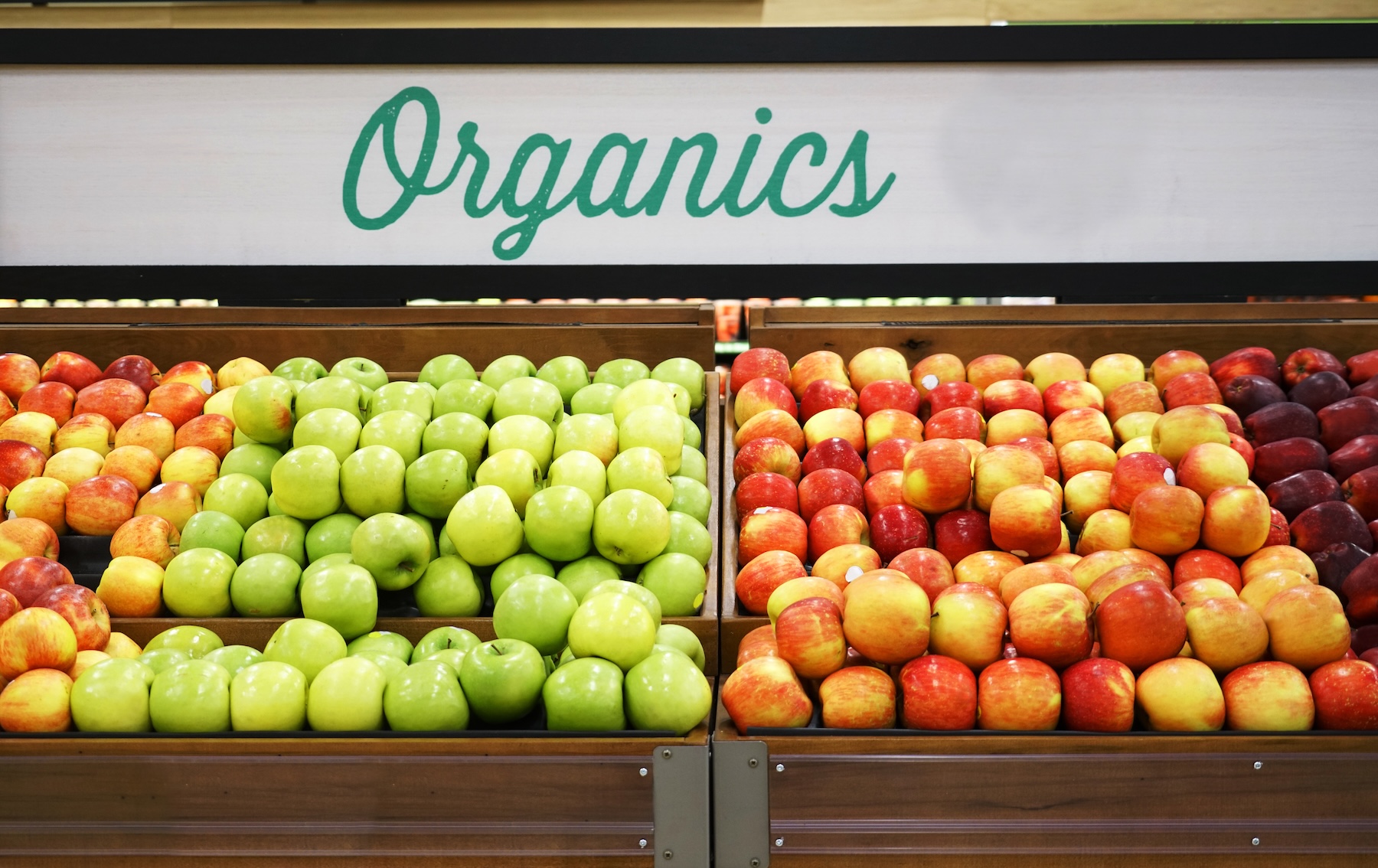
Organic apples and grapes show that pattern:
- Apples are up roughly +$5 million over three years
- Grapes are now a roughly $300 million category, adding about $35 million in the past year and growing steadily since 2023.
Dollar growth here is modest compared to potatoes, bananas and berries, but steady is what really matters here. Volumes hold. Distribution holds.
Price per pound moves with availability, but demand is not swinging wildly.
These are mid-gear segments that keep the performance high and round out the organic assortment for customers’ routine shopping habits.
Apples and grapes show up in daily snacks and meals, and shoppers pick them up without much thought about the trade-offs between conventional or organic.
That reliability gives the category its balance. Steady margins give growers, shippers and retailers room to plan and innovate. It also helps to keep organic present in the weekly shopping experience, even when consumers are tightening other parts of the basket.
When the ride feels smooth, these are the segments generating momentum in the background.
The Steep Climbs: Segments That Feel The Most Resistance
Some are uphill rides with more effort and lower returns. While pre-packaged salads remain the top-selling organic category at more than $1.3 billion, they’ve also posted some of the sharpest dollar and volume declines.
Distribution and commodity volumes are stable, indicating there’s consumer interest. Higher prices and perceived risk present the biggest challenges.
At $8.17 per pound, salads are among the most expensive organic items. And if an item spoils quickly, as salads sometimes can, a price premium is harder to defend.
The unspoken rule becomes, “I will not pay extra for something that might go bad or disappoint me.” Consumer logic changes. Organic’s value perception falls back and reducing waste in a household’s budget takes the lead.
Organic tomatoes are still growing in dollars (about 10% over three years), but volumes are falling. Tomato prices have increased more than other organic items, and this suggests organic shopper resistance to higher pricing.
Regardless, these segments matter. Salads, lettuce and tomatoes shape how the entire department presents itself. They are trip drivers, meal starters and visual cues for freshness.
A weak organic salad set can make the produce department seem lacking or outdated. The goal isn’t raw growth — it’s stabilization.
On these climbs, retailers and suppliers can win by strategically trimming assortments in favor of items that turn. Tight quality standards, realistic premiums and managing distribution of core SKUs are essential. These choices keep the department moving, even if the grade gets tougher.
Organic’s Journey is Showing Maturity
If you’ve ridden these roads, the top-line story starts to make sense. Organic is not shrinking. It is segmenting. Those gains in fast stretches are real and significant. The stability in the middle is quietly important. The pressure in the steep sections is important but focused.
When the parts of the journey blur and blend, organic produce looks flat. When you separate it, you see a system with very different speeds and a bright future.
There are several implications:
- Growth will continue to come from high-momentum segments where shoppers trust organic and use the product frequently. This holds true if the price is reasonable.
- Steady segments add stability by keeping organic in the cart week after week.
- Sensitive segments should be managed with care, because they influence perception and trips, even when their own numbers are under pressure.
Making the Right Shifts
Some organic categories are built for speed. Where distribution is strong, pricing is competitive, and shopper trust is established, returns tend to follow. These segments justify continued investment, promotion, and shelf space because they pull the category forward.
Other categories move at a steadier pace. Consistent quality, dependable supply, and rational pricing keeps organic present in routine shopping. These segments may not surge, but they provide balance and reliability across the assortment.
More mature organic categories require restraint. Higher prices and shopper sensitivity mean the focus should be on execution rather than expansion. Simplifying assortments, prioritizing core SKUs, and managing space carefully can protect performance while limiting risk.
Organic also moves as a group. Retailers drive visibility, suppliers define value, growers provide stability, and marketers shape understanding. When each plays its role, the category maintains momentum across changing conditions.
Rather than standing still, organic moves in different ways across the category. The leaders in the next phase will see those differences clearly and shift their effort to match the terrain in front of them.