
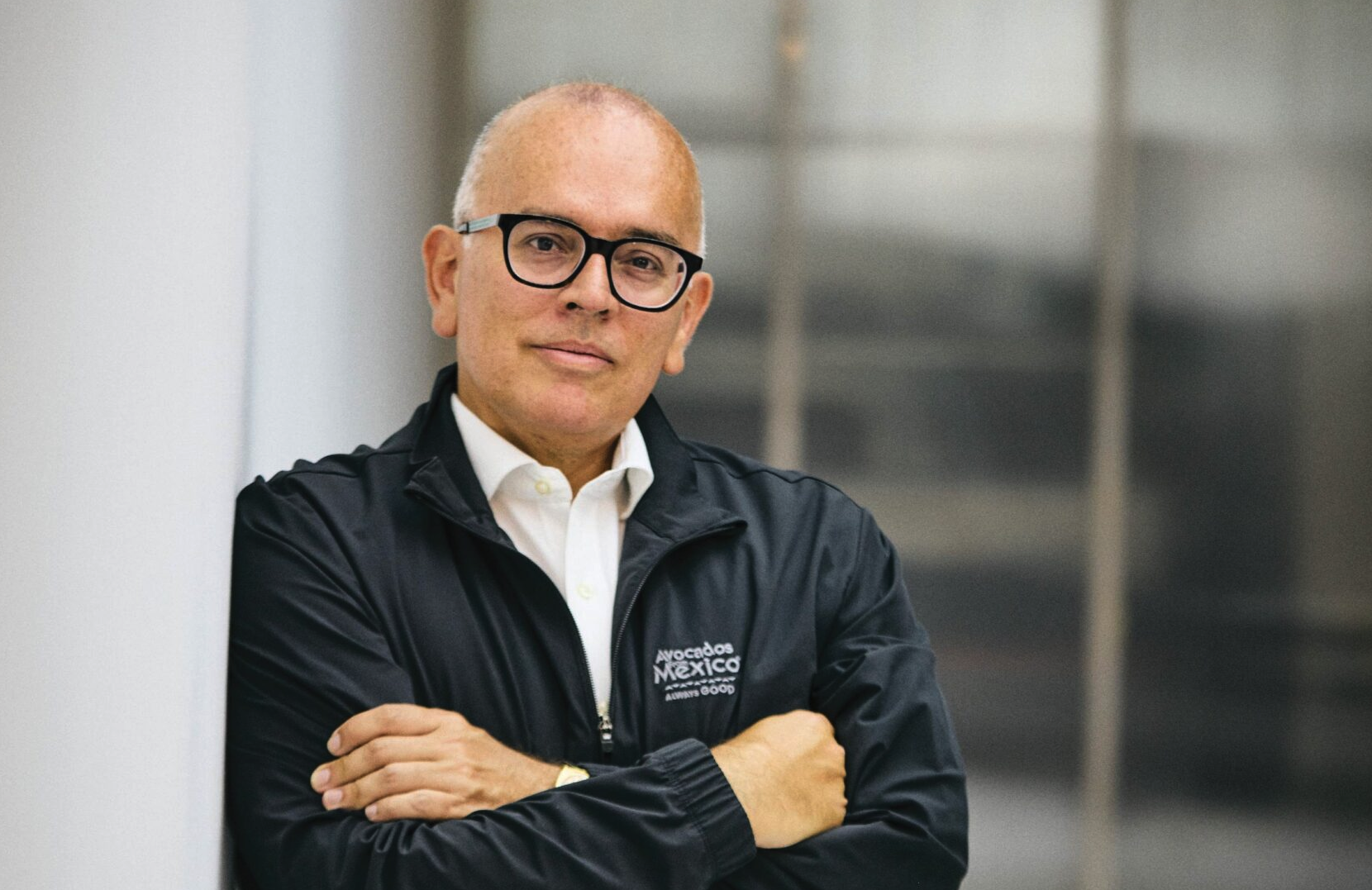
Alvaro Luque, the chief executive of Avocados From Mexico — an Irving, Texas-based nonprofit marketing organization — has spent more than three decades building demand around Mexican staple products, even though his own route began farther south. Born and raised in Costa Rica, Luque built his career in marketing, first in paper products and then in food. His work with Mexican food giant Gruma took him to Venezuela, Mexico and eventually the U.S., where he became vice president of marketing for their two U.S. companies: Azteca Milling and Mission Foods.
Fresh produce was not the obvious next step. “I was not a produce guy. I was a CPG guy,” he says. But when a recruiter approached him about Avocados From Mexico in 2013, he quickly saw the fit. The assignment, as he understood it, was to take a fast-growing commodity category and build it like a consumer brand. “This is my perfect dream job,” he remembers thinking.
That shift has helped define AFM’s position in the U.S. avocado market. Luque says Mexican avocado imports have grown from around 1.1 billion pounds when he joined the organization to close to 2.8 billion pounds in the latest crop year.
The organization has also become known well beyond produce for its unusually high-profile marketing, including Super Bowl campaigns, college football partnerships, retail activations and the kind of brand work more often associated with the center of the store. For Luque, that has always been the point: to prove that fresh produce can create the same emotional pull as packaged food.
In the following interview, Luque discusses brand loyalty, the next phase of U.S. avocado growth, the foodservice opportunity, sustainability, and why he thinks produce needs to take marketing more seriously.
What evidence convinces you that consumers are loyal to the brand Avocados From Mexico, rather than simply loyal to avocados?
That’s a great question, because it is very hard for a brand that lives in a commodity world to prove that.
When we started, we already had around 60% market share in the U.S., but only about 20% consumer preference. Most of the preference was with the California avocado program. So even though we were managing the volume, we were not top of mind with consumers.
In about six years, we turned that around. Today, preference for Avocados From Mexico is close to 60%, so most consumers in the United States prefer to buy Avocados From Mexico as a brand.
We also lead in awareness, satisfaction, quality perception and preference. If you compare us with CPG brands, we still have a long way to go, but in the produce world, those metrics are very high.
The second proof is reputation. When your brand has a voice at the Super Bowl, college football and Cinco de Mayo, and major marketing and consumer outlets are talking to you, you know you have created something beyond a commodity.
The third is the business side. When we started marketing 12 years ago, retailers did not want heavy branding elements in stores. Today, it is the opposite. We work with the largest retailers in the U.S. much as we did when I worked for CPG companies – developing integrated programs that bring the brand to life in the point of sale.
Finally, there is the passion from consumers. You cannot imagine how many people sing the jingle to us in airports, Ubers, taxis or at shows. When someone stops you and sings the jingle, that is when you see you have built an emotional connection.
How much of an advantage does having a year-round supply give Avocados From Mexico when it comes to brand development?
It has been a major advantage. A lot of produce categories are trying to build an emotional connection that only works for part of the year. That stop-and-go rhythm is very bad for a brand story. With Avocados From Mexico, we can keep nudging the consumer throughout the year, and brand building is really about that slow, frequent connection.
The avocado category has grown extremely fast. Do you think U.S. consumption still has significant room to grow?
The short answer is yes. We are on the route to tripling the business since I started at the organization.
If you had asked people a year or two ago whether this category could still jump into double-digit growth, many would have said no. They would have said, “It is a mature category now. We are growing 2% or 3% a year, and that is normal.”
This year, we proved the opposite. We are going to grow more than 20% in one year. That tells you there is still a lot of room to grow.
We also just completed our demand study, which we do every five or six years to define strategy for the next five years. With the current conditions in the U.S., the analysis showed the category could still grow close to 25% to 30%.
And that does not take into account one very important fact that, in my view, we haven’t even really started yet: the new generation factor.
When we started the organization in 2014, I pushed very strongly for Gen X because they had the economic power, but they were not born with avocados. We needed to educate them and connect the category emotionally.
Now our biggest marketing dollars are going toward millennials. Millennials and Gen Z were born with avocados. They invented avocado toast. They are the ones who will stand in line at Chipotle for half an hour for guacamole.
Imagine the opportunity we are going to have in 10 years when these generations control the economic power of the U.S.
When supply reaches the kind of record level seen in the most recent season, how do you make sure demand keeps pace rather than simply putting pressure on price?
It is not easy, because extra demand does not happen by accident. It has to be created.
This past year, when we were able to move more than 20% more fruit in one year, it was because we prepared with a very clear and aggressive commercial and marketing plan.
This company dedicates almost six months of the year just to planning. We start planning our marketing and commercial plans in the second week of November, and we present them in May. When we saw this monster crop coming, we knew we needed to activate different channels much more aggressively than in the past.
Unfortunately, this is a category that works by supply and demand. When you have very high volume, it will affect pricing. We would love to see a category that is more balanced in terms of value.
By balance, I mean stability in price. That is not something we manage because we do not sell fruit. Our job is to keep the category moving. If we do that, we support healthy pricing and value for the industry.
What is the biggest operational problem retailers still need to solve in avocados, and what advice would you give them?
There are two things I would highlight. The first is that this is a fruit. We do not have factories producing avocados every day like you do with sodas or crackers. It changes every year. Sometimes you have a big crop, sometimes a smaller crop. Sometimes you have small fruit, sometimes larger fruit.
One of the biggest opportunities for retailers is being more agile in adapting to the crop. We saw it two years ago when we had a lot of fruit, but smaller fruit. Some retailers moved fast, rethought assortment, created new SKUs and promoted different sizing. They did much better than the ones that stuck to their usual assortment and then suffered because the fruit they wanted was not there.
The other opportunity is managing ripening better and understanding what consumers need, instead of seeing it only through the retailer’s lens.
Some retailers stick to a green-fruit program, but consumers do not think like that. If I want guacamole today and you have green fruit, I am not going to buy from you.
The retailers that understand ripening as a marketing tool are going to be more successful. People live by the occasion, not by the retailer.
How important is foodservice in shaping avocado consumption, and how do you see demand from the sector evolving?
I have always been a big believer that the biggest runway for development of this category is in foodservice, not retail.
It has been harder to see that come through because foodservice is so fragmented. But many consumption habits start in restaurants. Restaurants drive a lot of what people eat, and they also develop many of the trends that move food categories around the world.
Retail still drives most of the volume. It represents more than 60% to 65% of all avocado volume in the U.S., while foodservice is close to 30%. But there is a huge opportunity.
It would be almost impossible to walk into a supermarket in the U.S. that does not have avocados. But how many restaurants are not serving avocados?
We think close to half of all menus in the U.S. showcase avocados in some way. Some build a business around avocados. Others have just one recipe with one avocado slice in it. So the opportunity is still huge.
Avocados are also still trendy. We are not a fad. Avocados have been cool for many years, and they are still very cool. They work in many different recipes, including bowls, and they are also an amazing value driver when restaurants offer “add avocado” for $1 or $2.
Where does guacamole fit into that foodservice opportunity?
Guacamole has a very strong force to develop volume. The clients that are serious about guacamole usually consume more than triple the amount of avocados compared with those that are not committed to a guacamole program.
If you are in the Mexican or Tex-Mex world, it is easy to see guacamole as a volume driver. But the bigger opportunity is to change that mentality.
Most of our volume in the U.S. today comes from non-Hispanic consumers. Guacamole is a true crossover recipe because it can belong naturally to both cultures. Prepare it in a Mexican molcajete, serve it with totopos, and it feels unmistakably Hispanic. Put that same guacamole in a bowl while watching the Cowboys play the Eagles, and it feels completely American. The recipe may be the same, but the preparation, setting and experience allow consumers to make it their own.
Consumers do not have those barriers. Foodservice still has them.
That is why we have been developing a program called Guac Heaven, where we give non-Mexican chains the tools, ideas and marketing support to use guacamole as a driver. There is still a lot of future in foodservice.
AFM has been active in digital marketing and sports partnerships. How do you judge whether those campaigns are actually moving fruit at retail, rather than just creating attention?
They must do both. Creating attention without driving sales has limited value, but driving short-term sales without building the brand isn’t sustainable. I believe long-term success comes from balancing brand-building and performance marketing. When you have the right mix – campaigns that keep Avocados From Mexico top of mind while also motivating consumers to purchase at retail – you create lasting growth for the category and the brand.
Sports marketing is very important for us. It is hard to find another brand that used the Super Bowl to develop both a brand and a category.
We made the decision to buy a Super Bowl ad when I was four months into the job, in our first board meeting. We invested half of our media dollars for that year in a 30-second ad. That changed not only the brand, it changed the category.
We became the first-ever fresh produce brand to advertise in the Super Bowl, went back seven times and did eight Super Bowl ads in total. But 12 years later, the reality is that we do not need it anymore. We already have a brand that is growing and strong in the KPIs and metrics we wanted.
Now we see sports differently. Over the last three years, our No. 1 investment has been college football. The Super Bowl is about impact. College football is about frequency.
Six or seven years ago, we said our biggest opportunity was OND, October, November and December. In the past three or four years, we have been breaking our records every year in that period.
The investment in college football is paying off big time to move volume. It still adds brand emotion, but now it is also focused on creating frequency of consumption around guacamole through a sports event.
How do you see competition between avocado origins evolving over the next few years in the U.S. market?
That is a question we always get, but we try not to see it that way.
When I started, we had around 60% market share in volume. It would have been easy to say, “Let’s go after the other 40% and try to dominate the market.” But our focus from the beginning was never domination. It was always about expansion.
My job is to make the pie bigger and make sure we have at least 85% of the pie. That is how we think.
Competition is healthy because it gives retailers other origins and makes them feel they do not have all their eggs in one basket. Other origins are good for the industry. I wish them well, as long as they share the vision of expanding the market with profitability.
But for us, the focus is somewhere else — it is not on dominating the 15% we do not have.
The avocado industry globally is facing more scrutiny over deforestation and water use. How is the Mexican avocado industry responding?
It is a very important topic for us. As market leaders, we have a responsibility to have a program in place. But as a marketing organization, we also need to understand the consumer.
We are moving more strongly toward younger generations, and Millennials and Gen Z place much more value on companies that are doing something for the environment than we did as Generation X. So this has to be a priority for Mexico.
A little more than a year ago, we launched our Path to Sustainability, with four commitments for the future.
One is water. We know avocados are intensive in the use of water, but Mexico has a positive story there. More than 65% of our groves do not even have irrigation. We depend on rainfall, and much of the rest uses environmentally friendly practices, like micro-sprinkling and drip irrigation.
The second area is biodiversity. The avocado-growing region is very rich in biodiversity, and we want to conserve, protect and restore local ecosystems. Bees also play an important part in that story.
The third is climate. Our objective is to be net zero in terms of carbon footprint by 2035, because of the carbon sequestration from the trees in our avocado region.
Finally, there is deforestation. That has been a strong issue for the category and for Mexico specifically. We also have the objective of being net zero in terms of deforestation by 2035. We are working with local authorities and the federal government to put the right tools and laws in place, so we can ensure every orchard exporting avocados into the U.S. is compliant.
In 2027, we will have to report for the first time on our environmental commitments. So we are taking this seriously, big time.
AFM has brought a CPG-style marketing model into a fresh produce category. What advice would you give other produce brands, especially those that do not have year-round supply?
The biggest advice I always give is to believe in the power of marketing.
That is still not very common in the produce industry. As an industry, we do an amazing job throughout the value chain: farming, water stewardship, transportation, logistics and quality. You go to any show and see companies putting beautiful tomatoes, onions and avocados in front of the consumer.
But then we forget the last part. In front of that tomato or onion, there is a consumer. A consumer who has one stomach and who, while buying carrots and cucumbers, is also thinking about pizza, hamburgers and crackers.
All those other companies are marketing to their mind and their passion points, and we are doing nothing. We take the consumer for granted.
The missing link is the emotional, commercial and promotional connection you can create with the consumer to sell everything you have done such a good job bringing to the store.
Seasonality is hard. I get it. But that does not mean you cannot do it. Mandarins are a great example. They are not there the whole year, but they have a brand, an identity and a connection with the consumer.
Produce brands need to believe more in marketing, and they need to invest behind it. You can have a lot of passion, but if you do not have the dollars, it is going to be very difficult.
What is your vision for the global avocado industry, and more broadly for the produce industry?
I would love to see this industry believe more in marketing and in building meaningful connections with consumers.
My legacy, hopefully, will be helping the produce industry recognize that marketing is not an expense – it is an investment in long-term growth. If, in 15 or 20 years, we see more produce brands evolve the way Avocados From Mexico has, we will be competing for consumers’ attention and loyalty alongside the biggest brands in the center of the store.
As a brand, we want to continue growing and developing the avocado category. But our ambition goes beyond selling more fruit. We want to inspire people to choose fresh foods more often and make avocados part of everyday life.
At the end of the day, our purpose is simple: to make people healthy and happy. That’s the impact we aspire to create, and that’s where we’ll continue to focus.