

Hernán Garcés Echeverría has spent more than four decades helping build Chile’s cherry industry into what is now by far the world’s largest exporter of fresh cherries. As president of Garces Fruit — widely regarded as the largest cherry exporter in the world — he has been at the center of Chile’s transformation from a niche supplier into the driving force behind China’s booming cherry market. From its headquarters in San Francisco de Mostazal, in the heart of the country’s main cherry-growing region, Garces Fruit ships more cherries than any single operation on the planet. According to Garcés, the company is also Chile’s largest exporter of plums, kiwifruit and nectarines.
Founded in 1965, the company operates three major processing plants in Chile and has maintained commercial offices since 2009 in the United States, in Wilmington, DE, and since 2017 in Shanghai, China — an international footprint that reflects the scale Chile’s cherry industry has reached over the past decades.
For years, that expansion delivered extraordinary margins and seemingly unstoppable growth. But after two difficult seasons marked by heavy volumes and weaker returns, Garcés thinks the industry is facing its first real stress test. The 2025-26 campaign, which kicked off in earnest in November, began with projections of more than 130 million boxes — around 650,000 metric tons (about 1.4 billion pounds) — of Chilean cherries heading to global markets, most of them bound for China.
“The cherry business was developed by and for China,” says Garcés. Yet he also says the industry is entering a new phase. “A cycle has ended,” he notes. The challenge now is not whether the business remains viable, but how Chile’s cherry sector adapts to a market that has grown larger, more competitive, and far less predictable.
In this conversation, Garcés discusses branding, margins, market concentration, and the strategic shifts he thinks the industry must make to remain competitive.
What is your analysis of the 2025-26 season?
Let’s see, each new season leaves us with a lot of lessons. This is a business that has been doubling every five years. That is something wonderful. Of course, we must try to diversify and develop more markets, but also become more efficient, generate new alliances, explore different distribution channels, and create new ways of adding value throughout the chain.
If the cherry market has matured and China has become less predictable, do you think the Chilean industry is addressing this change of cycle appropriately?
It is undeniable that the industry incorporated the lessons from the previous season. For example, sizes this year were much larger. In addition, we are extending the season, planting both in the south and in the north of the country. That creates a different scenario.
With the extension of the season, is there not a risk that cherries could lose their premium status?
No. The cherry continues to be a coveted gift. I do not agree with those who argue that cherries have become a commodity. But the market has matured. This is no longer about packing and shipping. There is a lot of volume, the Chinese economy is slower, and cherries have ceased to be that almost magical product that sold itself.
What should the Chilean industry do? Reduce volume, change varieties, become more efficient?
Quality, before anything else. And at the same time, something that is talked about very little: brand building.
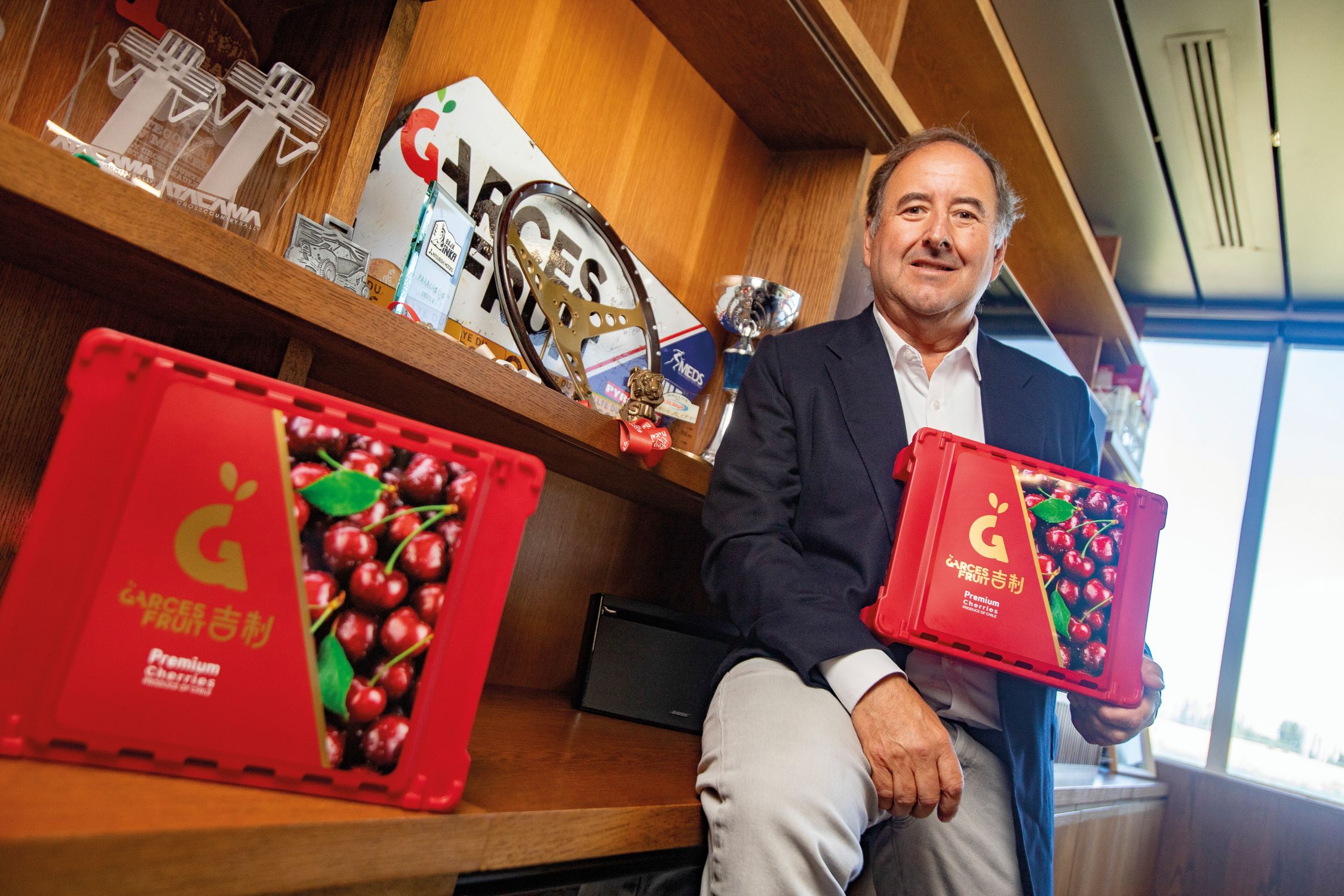
How do you assess the role of Frutas de Chile (the industry association representing Chilean fruit exporters) as an articulator of Chilean cherry promotion, particularly in China?
Frutas de Chile has done an excellent job, and not only in promotion. The cherry business is much more than selling: you must stay on top of phytosanitary matters, logistics, port coordination, relations with the Chinese government, presence at trade fairs, and so on. In all of these areas Frutas de Chile has been an extraordinary coordinator.
Returning to the brand issue, the “Frutas de Chile” umbrella is very important, but it is also fundamental that each exporter properly develops its own brand. It is the only way you can add value to your quality and consistency. When a business is very good and the cost of entry is not very high, as is the case with cherries, you have more than 300 exporters. With three brands on average each, that is 900 brands in the market. How do you differentiate yourself among 900 brands?
How have you done it? What has been the formula for Garces Fruit to be perceived as a consistent brand in the Chinese market?
First of all, with the alignment of our growers, with whom we have worked for many years and who fully trust our work. That allows us to pack top-level fruit throughout the season and guarantee our clients a consistent product and brand. This applies to China and to the 30 markets and hundreds of clients that we export our fruits to.
In addition, in China we carry out omnichannel marketing and promotion campaigns: influencers, social media, trade fairs and events, points of sale, everything you can imagine. There has also been a lot of trial and error; we test quite a bit and, of course, we persist with what works for us. But the keys to our success have been, and will continue to be, consistency and the quality of our fruit. When a Chinese TikToker puts their name and face behind promoting our cherries, they know their reputation and credibility are not at risk — on the contrary.
Regarding sales channels, do you find retail more attractive than the wholesale market? I ask because alliances with retailers can favor joint brand-building efforts.
Look, here I think you need a combination of everything. You have to build alliances with retail, maintain a presence on TikTok, and sell through e-commerce. We have even sold cherries in vending machines, in 200-gram cups; we also do a lot of home delivery. Ultimately, there are various ways to reach the market, but in any case what should guide your strategy is being closer to the consumer and achieving brand recognition.
Beyond brand and promotion, where does the transformation of the business lie?
This business has to become more efficient — in the fields, throughout the production chain, in all its processes. We have to be a reliable brand, arrive only with top fruit: large, flavorful, and of the best quality and condition. Last year, the industry had 65% of fruit in sizes above 2J, one of the larger commercial cherry grades, and this season we reached 70%. Well, next season we will have to reach 75%.
The Chinese do not want small fruit; they want consistency, meaning that from the first to the last box of the season the fruit has identical premium quality. If you achieve that, you already have a very important competitive advantage. We must be absolutely clear: quality plus consistency must be the main competitive advantage of Chilean cherries.
Does this new scenario mean getting used to tighter margins?
The business clearly will no longer be the same. Perhaps we will have to work twice as hard and earn half as much. But we must understand that for years this business was absolutely extraordinary, sensational, crazy. We created from zero a business that did not exist, and together we grew it to dimensions that no one ever imagined.
Given the way the business has evolved, up to the maturity you describe, is there something the industry could have done better?
This was done very well. It is impossible that we built a three-billion-dollar business by doing it badly. As I said, what happened is simply that the business matured. All businesses mature, and cherries could not be the exception. The market became more complex, the consumer more demanding, and as a result being competitive now is more difficult, more challenging than before.
In an old orchard you harvested seven or eight tons and were still profitable. Today, no. Before you could pack second-grade fruit. Today, no. If you have an orchard that produces small fruit, you will have to renew that orchard or find a way to make it produce larger fruit. There is no alternative: either you update yourself according to what the market is asking for, or you are left out of the business.
In the industry, the example of Zespri is often mentioned — a single-desk export marketing system that coordinates the global sale and branding of New Zealand kiwifruit. Do you think anything like that could work for Chilean cherries?
In Chile, there is no legislation for a model like that, and we have to abide by the existing legislation, period. If the legislation does not allow it, it is not a good idea (laughs). In addition, Zespri is a completely different reality. They are one single brand; we are 900. It is good that we have the “Frutas de Chile” seal, but how do you achieve consistency across 900 different brands? Impossible. There are hundreds of different plants, strategies, objectives, ways of working.
I have been in this business for 42 years. I know what I have to do. I know what consistency is. I know what it means to stand in front of the supermarket. I know what it means to be on the front line. I think it is fine for there to be recommendations, but that is very different from having an entity with the power to regulate and dictate the guidelines of the business.
The industry often talks about diversifying markets. Is it viable to reduce dependence on China in the short term, or does that discussion distract from the focus that, as you have said, should be quality and consistency?
We have to conquer the entire world. But the reality is that Americans consume six or seven grams of Chilean cherries on average, Europeans four or five grams, and the Chinese almost 500 grams. At Garces Fruit we sell to more than 30 countries, and believe me we push all 30.
We run promotional programs in Europe, in the United States, in other Asian countries. But 90% is still eaten by China. It is not easy to diversify. It is not that we do not try or that we are sitting comfortably with what China offers us. We even have targets related to opening new markets, but reality continues to tell us something else.