
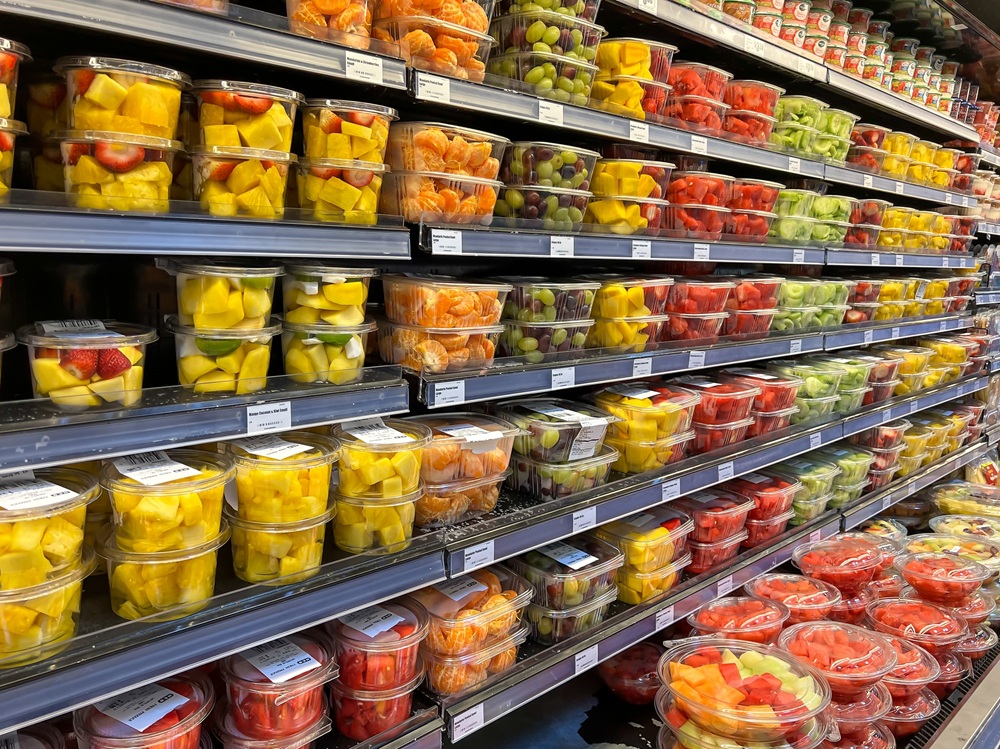
The chip aisle is getting nervous, and for good reason. While those center-store snacks gather dust, America’s shopping carts are veering hard toward the perimeter, where refrigerated cases now burst with hummus packs, fruit cups, pre-cut veggie sticks, and bento-style protein packs that would make your lunchbox-toting childhood self weep with envy.
This isn’t the traditional produce section many people grew up with. It’s a high-margin playground where single-serve guacamole cups sit next to sushi trays that somehow, against all culinary odds, actually taste good despite coming from the same store that sells motor oil and birthday cards. The data backs up what snack-stained car consoles already know: Hartman Group, a market research firm, reveals that 49% of eating occasions are now officially “snacks,” with nearly half of Americans grazing three or more times daily.
Post-pandemic life has steered many consumers away from the traditional three-meals-a-day routine. Instead, it’s cemented our relationship with these portable, perishable indulgences that somehow make consumers feel virtuous despite paying a 300% markup for pre-sliced apples.
And grocers, watching those beautiful margins, couldn’t be happier about it.
Health, Portability & Modern Routines
Snacking now stands shoulder-to-shoulder with traditional meals. Why? It first starts with lifestyle. Modern schedules leave little room for elaborate meal prep. According to Hartman Group, 90% of fruit cup buyers rank “getting enough to eat/drink as quickly as possible” as crucial, while 89% value “not needing energy to prep.” Also, 56% of consumers say they can’t finish the day without a snack.
Sally Lyons Wyatt, global executive vice president and chief advisor of consumer goods and foodservice insights at Circana, another market research firm, notes, “It’s not just a grab-and-go society anymore — it’s a snack-for-any-meal moment.”
Health consciousness drives much of this trend, too. According to Lyons Wyatt’s research, 64% of consumers now seek snacks that are “good for them” — a 7.4-point jump since 2020. The research also shows 41% of consumers buy snacks specifically to support diet goals. The morning hours particularly showcase this priority, with better-for-you snacks over-indexing during early-morning and breakfast (127 and 122, respectively). The Hartman Group also reports that 75% of consumers want more fresh fruits and vegetables as snacks, while 63% seek high-protein options like cheese cubes, yogurt, or hummus.
Quality matters tremendously, too, as 92% of fruit cup buyers prioritize “simple, real ingredients” in their top three needs. Lyons Wyatt notes that growth stars in this space include yogurt drinks, frozen/dried fruit, cheese chunks, and sushi. She adds, “We now have a more educated consumer. They’ve learned a lot about what’s in products.”
The emotional aspect shouldn’t be overlooked either. Fresh snacks contribute to physical, mental, and emotional well-being — with 56% snacking for self-reward or comfort, produce offers guilt-free satisfaction.
Demographics & Consumption Patterns
College kids are grabbing protein packs between classes. Harried moms are stashing fruit cups in purses. Fitness enthusiasts are loading up on veggie dippers. A colorful mix of snackers — spanning generations, income levels, and lifestyles — shapes how America eats today and creates both challenges and opportunities for grocery retailers.
Gen Z and millennials are driving the snacking trend with remarkable enthusiasm and consistency. When afternoon hunger hits, 86% of Gen Z and 77% of millennials reach for snacks rather than traditional meals, according to Hartman Group research. These digital natives demand options that slide effortlessly into backpacks, car cup holders, and packed schedules.
Melissa Abbott, VP at Hartman Group, cuts to the heart of it: “Younger shoppers are driving interest in healthful snack kits — they want flavor, nutrition, and ease all in one.”
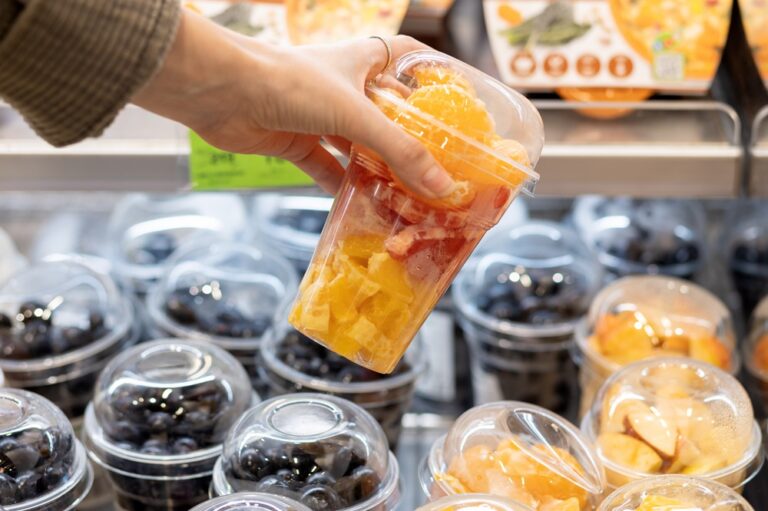
That said, money complicates everything. “Produce snacking normally attracts medium- and high-income consumers unless priced affordably,” notes Lyons Wyatt. Yet remarkably, 61.5% of consumers willingly pay premium prices for high-quality snacks — a figure that jumped 5.6 points in a year. Simultaneously, shoppers have grown savvier about price-per-serving value (up 1.6 points) and spread their dollars across diverse retail channels.
Parents wield significant influence in the snacking marketplace, too. Their carts overflow with pre-portioned packs that help ensure kids are fed on the go, preventing hunger meltdowns, covering for forgotten lunches, and fueling everything from car rides to sports practices. One smartly packaged snack solves multiple family pain points at once.
Then there’s gender, creating another dimension in snacking preferences. Women gravitate toward plant-based options more strongly, making vegetable-forward snack packs particularly appealing to female shoppers.
So, needless to say, savvy retailers must capitalize on all of the above through strategic merchandising that speaks to different motivations.
Margin Wins and Aisle Innovation
Grocery executives practically high-five when discussing fresh-snack category performance. While shoppers load up on grab-and-go produce packs, retailers celebrate the profit potential and strategic advantages these items deliver across store operations.
Fresh snackable items deliver killer margins that make category managers downright giddy. Value-added prep and convenient packaging transform basic produce into premium purchases. Dr. David Just, Professor of Behavioral Economics at Cornell University, puts it bluntly: “Produce is one of the highest-margin sections in grocery… retailers are eager to push these items.” And clearly, for good reason.
Look at the numbers. While other categories struggled in 2024, snackable produce muscled out a 3% volume growth, according to Lyons Wyatt’s research. More impressively, she notes that “meat-cheese-dessert kits saw double-digit growth” during the same period.
Placement strategy turns these products into profit engines. Old-school grocery wisdom kept fresh items anchored to the perimeter. Yet, today’s retail innovators break those rules, pushing snack-ready options into central store territory. Take, for example, the secondary coolers near checkout — far from being randomly placed, these are carefully designed impulse zones. Experiments conducted by Dr. Just back this up: “We saw a 10% boost in produce sales just by using arrows and signage to nudge choices.”
Timing plays a crucial role, too. Morning commuters grab fruit-yogurt combos while afternoon shoppers reach for veggie-hummus packs. Hartman Group’s research shows these daypart patterns aren’t accidental, and smart merchandisers capitalize on these trends with targeted placement and promotions that speak to specific hunger moments.
Cross-merchandising amplifies these effects. That’s why you’ll find complementary pairings — fruits with dips, proteins with vegetable sides — strategically positioned together, creating complete snacking solutions that drive larger basket sizes and higher satisfaction.
Price strategy completes the picture. Private-label fresh snack kits give budget-conscious customers accessible entry points while preserving healthy margins. In fact, private labels outpaced branded options last year as shoppers embraced value without sacrificing quality. Lyons Wyatt also identified a fascinating “barbell shopping” pattern where consumers grab club packs for volume savings or single-serve when cash tightens. While 34% of shoppers still fixate on unit price, Hartman data reveals 31% now weigh factors like shelf-life and portion control just as heavily.
Different retail channels tell different parts of the story. Club stores (snack sales up 2.7%), military outlets (volume soared 17.3%), and even dollar stores (units grew 3.0%) each demonstrate how format innovation meets specific shopper needs and budgets.
Packaging & Sustainability: The Double-Edged Sword of Convenience
While retailers celebrate these items’ high margins, packaging engineers face mounting pressure to balance convenience, freshness, and sustainability — a complex mix that can make or break a product’s success. The perfect fresh snack package walks an increasingly difficult tightrope.
Convenience remains non-negotiable. Lyons Wyatt says, “Packaging must allow for on-the-go use — in the car, train, or walking.” No matter how nutritious or tasty the product is, it fails if consumers can’t easily eat it during their commute or between meetings. This functional demand drives design decisions from closure mechanisms to container shapes.
Consumer feedback reinforces these priorities. “I like to see what the fruit looks like before I buy,” explains Keiara, a 33-year-old consumer, to Hartman Group, and sums up why clear packaging dominates the category. Meanwhile, the ability to reseal ranks exceptionally high for shoppers who graze throughout the day rather than consuming in one sitting. Easy to open, no mess, and consistently scores as a top functional benefit that shoppers won’t compromise.
Freshness preservation presents another critical challenge. According to Hartman Group research, Modified Atmosphere Packaging (MAP) and Controlled Atmosphere Storage (CA) technologies have revolutionized shelf life without adding preservatives. These innovations extend viability while maintaining the “clean label” attraction to health-conscious consumers.
Still, balancing sustainability with convenience remains one of the most difficult challenges. Single-serve formats provide perfect portion control but generate more packaging waste — a contradiction not lost on environmentally conscious shoppers. Dr. Just frames one unexpected benefit: “Intermediate packaging creates a visible record — so people snack more mindfully,” potentially reducing food waste through more controlled consumption.
Some consumers actively weigh these tradeoffs. Rashmi, 35, explains her reasoning to Hartman: “Multi-serve gives you more for the unit price, and you generate less waste.” Thus, growing awareness of packaging’s environmental impact pushes brands toward recyclable materials and right-sized containers that minimize excess.
Innovation & Growth Pathways
Fresh snacking’s evolution won’t slow down anytime soon. While retailers optimize displays and packaging engineers balance competing priorities, forward-thinking industry leaders are already mapping the next wave of innovations to propel this high-margin category even further.
Tech-enabled freshness tops the priority list for extending both reach and relevance. “Tech that enables greater freshness with methods like MAP and CA storage will help reduce microbial growth, prevent dehydration, and maintain sensory qualities without added preservatives,” predicts Abbott from Hartman Group. The beauty? Many advances happen behind the scenes, “less visible to consumers” yet critical to scaling fresh snacks across new channels and formats.
Modular and mix-and-match packs also promise to satisfy growing consumer demand for personalization. Abbott forecasts a shift toward flexible solutions: “Modular snacking will rise in popularity, with mix-and-match offerings crafted with simple, clean ingredients, and bolder flavors.” Lyons Wyatt also sees additional strategic potential, with retailers leveraging these smaller packs as discovery engines: “An opportunity for innovation is even having some of these package sizes be looked at as trial. Retailers could package it up and say, ‘Have you ever tried this?’”
Additionally, smaller households and quick-trip retail create structural tailwinds for single-serve produce. Dr. Just connects demographic shifts to format opportunity: “If we continue with this trend toward people in smaller households, it will all focus on smaller portions in the home.”
Meanwhile, digital and delivery acceleration opens additional growth avenues. “Food delivery is up and on a growth trajectory again,” notes Dr. Just — creating expanded opportunities for impulse-friendly fruit cups and veggie kits ordered online. Brands that make their products easy to find both in stores and online are better positioned to succeed across any shopping channel.
And then, there’s the growing influence of GLP-1 medications and brain-health nutrition — two powerful forces that could shape the next wave of consumer behavior. GLP-1 drugs, such as Ozempic and Wegovy, were originally developed for diabetes but also suppress appetite, and are now widely used for weight loss, shifting how consumers think about food. At the same time, brain health is emerging as a mainstream wellness priority, with more consumers seeking foods that support cognitive function, mental clarity, and emotional well-being. Lyons Wyatt connects future demand to wellness megatrends: “With almost any brain diet or GLP-1 diet… these snack-size portable options are ideal, but you have to be able to afford them.”
The Future is Modular, Mobile, and Mindful
Those little fresh snack packs have become retail’s secret weapon in the battle for shopper dollars because they deliver exactly what people crave: nutritional benefits (not just empty “health” claims), true convenience (because who has time for a proper meal?), and packaging that at least tries to nod at sustainability while keeping car seats safe from hummus disasters.
Shoppers still wince at inflation throughout the store. Yet, they keep tossing these premium-priced produce packs into their carts without hesitation. That $6 container of pre-cut pineapple somehow seems worth it when it promises both immediate gratification and health benefits.
Traditional snack brands must be seething with envy. The savviest retailers have turned these items into absolute cash machines. They’ve mastered the art of putting that single-serve guacamole exactly where consumers will cave to temptation, pricing it just below a mental “that’s ridiculous” threshold, and packaging it so cleverly that consumers will finish it before it turns brown. It’s brilliant merchandising disguised as helpful convenience. As Abbott puts it with crystal clarity: “Consumers no longer separate snacking from eating — they’re looking for solutions that work in the moment and contribute to long-term wellness.”
Translation for retailers: The lines between meals and snacks have completely blurred, and there’s serious money to be made in that delicious confusion.