
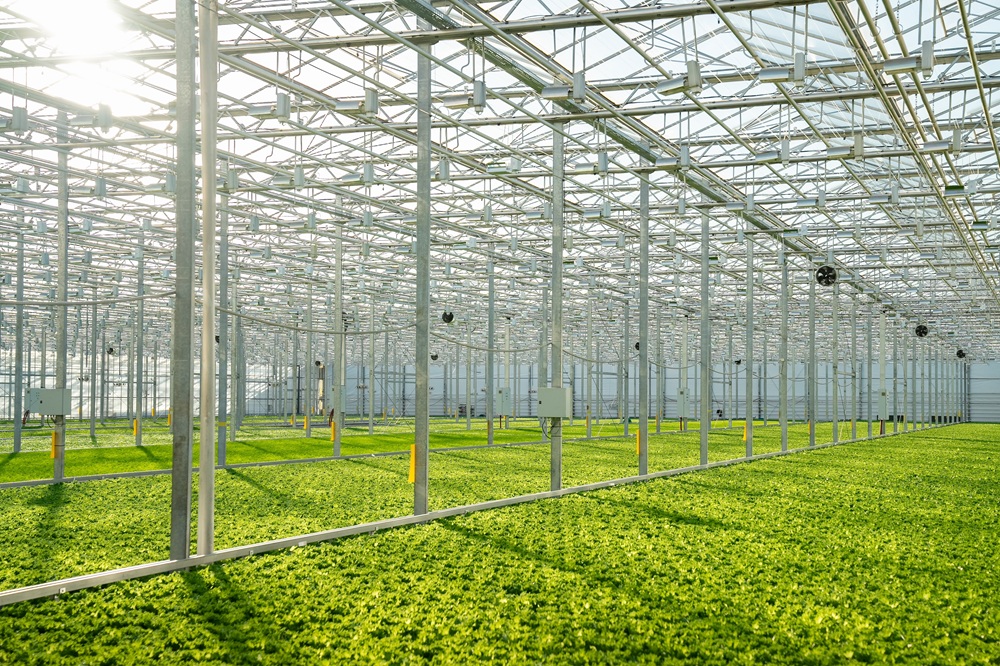
Unpredictable weather has long challenged growers, with floods, droughts, and heat waves capable of wiping out an entire season. To reduce risk and gain greater control, more producers are turning to controlled-environment agriculture (CEA) — from high-tech greenhouses to vertical farms. What was once the domain of well-funded startups is now evolving into a more established part of the fresh produce sector.
USDA data from 2024 shows that the number of U.S. CEA operations doubled between 2009 and 2019 to nearly 3,000 facilities. Today, the U.S. CEA market is valued at approximately $7 billion. Tomatoes, lettuce, and cucumbers account for 60–70% of total output, with market penetration continuing to grow. “Over one-third of all fresh tomatoes grown in the U.S. are greenhouse-grown,” says Tom Stenzel, executive director of the Controlled Environment Agriculture Alliance. For leafy greens, the numbers are also telling: “We’ve surpassed 5% of the national salad market — and over 20% in the Northeast,” says Stenzel.
Canada plays an important role in cross-border supply. The Royal Bank of Canada (RBC) says that the greenhouse industry is worth $2.5 billion, with the country running 920 greenhouse facilities across more than 5,000 acres, pumping out 800,000 tons in 2023 alone. Matt Quiring, senior vice president at Leamington, Ontario-based Nature Fresh Farms, notes, “Ontario glasshouses ship millions of pounds south every month; our job is to be a ‘powerhouse stabilizer’ that keeps U.S. shelves full when California or Mexico hiccup.”
The early venture capital (VC) frenzy that funded startups like Bowery and Plenty has cooled after some expensive failures, but Stenzel notes the sector faces an “industry recalibration — financial discipline replacing the early VC rush — yet insiders think the reset will leave the stronger operators standing.”
The Sustainability Claims That ‘Hold Water’
With early enthusiasm tempered by experience, more reliable data is now emerging. “We don’t treat energy as a cost line — we treat it as an input to consistency. Every LED watt tracks back to flavor, yield, and shelf life,” says Quiring. Leading operators emphasize consistency and output over energy input alone.
Retailers now have defined benchmarks. Stenzel notes, “Our CEA Alliance Sustainability Framework lays out 22 concrete metrics — land, water, energy, worker welfare — so retailers can compare greenhouse, vertical, and field claims apples to apples.”
Water efficiency delivers the most dramatic wins. Closed-loop systems can reduce water use by up to 90% compared to open-field farming. A 2024 iGrow News article cited a University of Arizona study that found hydroponic lettuce used only 10% of the water needed for its field-grown equivalent.
Quiring reports water-savings data are “now part of every retailer discussion,” while Stenzel notes retailers focus on “surety of supply and consistent quality.”
The land-use numbers are also striking. Canadian greenhouse tomatoes yield roughly five times more per acre than field tomatoes, while greenhouse herbs yield 30 times more than their outdoor counterparts, according to a May 2025 report from Farm Credit Canada (FCC), a Crown corporation and agricultural term lender. RBC also reports that the country’s greenhouse sector out-produces benchmark regions by massive margins: 4.6-fold more produce per area than Spain and 2.6-fold more than Mexico. Year-round production, carbon dioxide (CO2) enrichment, and multiple harvests per year have driven those gains.
Nutrient efficiency tells a similar story. Reportedly, advanced sensor systems allow up to 95% of applied nutrients to reach plants, versus roughly 50% efficiency in conventional fields. The rest used to flow into waterways, but automated controls and AI algorithms now fine-tune nutrient mixes in real time, cutting fertilizer waste and chemical runoff.
CEA enables production close to population centers year-round, shrinking supply chains and cutting transport emissions. This factor supports year-round local supply and reduces reliance on long-haul seasonal imports.
Climate resilience might be the biggest selling point of all. Indoor farms shield crops from weather extremes that regularly hammer field operations. Floods, droughts, cold snaps, and heat waves barely register when crops grow under glass or LED lights.
Persistent Challenges in CEA
The sustainability perks, though, come with some serious asterisks. And the industry’s biggest advocates will attest to this.
Energy intensity tops every operator’s nightmare list. “For high-tech glasshouses, power is the single biggest risk line; most growers now sign three-year hedges just to sleep at night,” says Cindy van Rijswick, global strategist for fresh produce at RaboResearch Food & Agribusiness. RBC also reveals that Canadian greenhouse energy costs jumped 55% from 2013 to 2023, much of it from fossil fuels. Quiring doesn’t expect this to change anytime soon, either: “Grid gas will underpin the baseload for several years.”
The sector faces what experts call an “energy trilemma” — cut carbon emissions, slash utility bills, and maintain steady power all at once. Lighting and climate control devour electricity, while many North American greenhouses burn natural gas for heating and CO2 enrichment. Vertical farms, which rely entirely on LED lights, use even more electricity per pound of produce.
Stenzel argues the focus should be on energy per pound of food, not total usage, and suggests field benchmarks should include tractors, irrigation, and transport.
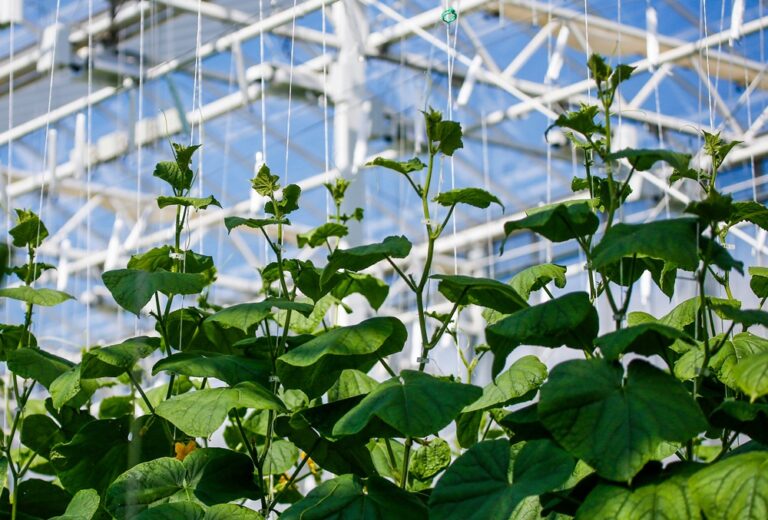
Capital costs are another challenge. Advanced facilities demand massive upfront investment for land, structures, climate systems, automation, and LEDs. Operating expenses follow suit — Canada’s greenhouses saw operating costs rise roughly 6% per year over the past decade, barely keeping pace with a 6.4% revenue gain, according to FCC. That narrow gap means many CEA businesses tread water just to break even.
Other pain points add to the complexity. Only a limited range of crops — tomatoes, cucumbers, peppers, lettuce, herbs, and strawberries — work at commercial scale, while staples like potatoes, carrots, and grains remain economically unviable in controlled environments. High-density greenhouse zones also create environmental considerations such as packaging waste and spent growing materials. And without access to clean energy, the carbon footprint per kilogram can rival that of long-haul imports. Labor and infrastructure add further strain: specialized workers are in short supply, and new facilities often face competition for essential municipal services like electricity capacity and water access.
Where CEA Stands Commercially
Despite the challenges, the market fundamentals keep pushing CEA forward. Retailers in urban centers from New York City to Vancouver stock more local greenhouse salad greens and vine-ripe tomatoes, drawn by year-round consistency and quality. North Americans expect fresh produce in January, and CEA fills those seasonal gaps when California fields go dormant.
“Cross-border used to be a challenge of distance; today it’s a challenge of precision. We time harvest, cold-chain, and routing to hit shelf-life targets because freshness is the No. 1 driver of where shoppers buy,” says Quiring.
Trade dynamics reveal how dependent the U.S. has become on greenhouse imports. According to RBC, fresh tomato imports rose 176% since 2000, and today 60% of all U.S. tomato imports come from greenhouse operations. Some U.S. retailers see this foreign dependence as a strategic vulnerability, spurring interest in domestic CEA.
Take Canada as a model. Over the past decade, peppers, cucumbers, and tomatoes went from net imports to net exports, as revealed by FCC. RBC also shows that Canadian production now meets or exceeds national demand for those crops, with Quebec aiming to double greenhouse acreage to $620 million in 2025. Leamington, Ontario — known as the ‘Sun Parlour’ — has become a North American hub, and big Canadian growers like Nature Fresh Farms, Mucci Farms, Sunset Produce, and Pure Flavor have expanded into U.S. facilities.
Access to low-cost capital tightened in 2024, and many earlier ventures either failed or changed hands. But van Rijswick sees this as a shakeout, not a shutdown: “Yes, venture capital and private equity have cooled, but serious lenders still back growers with cash-flow discipline. Green bonds and bank loans are filling the gap while the vertical-farm bubble bursts.”
Experience trumps spreadsheets when money gets tight. “It’s more the people running the business than any metric,” van Rijswick cautions — agronomic know-how remains the decisive factor. Quiring puts it bluntly: “Yield per square-meter, labor efficiency, and shopper preference — if an innovation doesn’t move those needles, we don’t chase it. Greenhouse isn’t a startup; we’ve been profitable for 28 years because the model delivers return on investment.”
Scale makes or breaks operations. Large greenhouse chains spread fixed costs over massive output, while smaller vertical farms survive by focusing on niche markets. Some retailers experiment with rooftop gardens to own their supply, while conventional farmers add greenhouses to diversify. Thin margins mean competitiveness hinges on driving down input costs and boosting yields — exactly what buyers evaluate when comparing CEA to field-grown.
Policy support on both sides of the border also plays a part. Canada offers federal research funds and tax credits through the Greenhouse Competitiveness & Innovation Initiative, plus provincial energy rebates. The U.S. launched USDA grants for urban agriculture and crop insurance pilots for greenhouse produce. Canadian lobbyists successfully pushed the USDA to ease import restrictions on greenhouse tomatoes and peppers, integrating North American markets.
Even with that support, the business case remains delicate. Rising costs and cheaper imports can quickly erode margins. Tariff changes or overseas production surges could undercut domestic CEA. Over-reliance on a few crops exposes growers if they aren’t diversified. Because in this business, the numbers change faster than the weather.
Where CEA Goes From Here
The sector is poised for a period of consolidation and expansion. Market forecasts suggest greenhouse and vertical farming could double or triple in the next 10 to 20 years, and provinces like Ontario and Quebec have launched growth strategies to scale up acreage. As Stenzel puts it, “We firmly believe that CEA will become an ever-more important part of the agricultural mix.”
Consumers are also playing a role. “When shoppers see indoor-grown as the gold standard — trusted, transparent, tastier — the whole supply chain will pivot indoors,” says Quiring. “Don’t look at greenhouse as an alternative. Year after year, we keep chipping away at field share because retailers — and families — vote with their taste buds.”
According to van Rijswick, consolidation will also unlock new opportunities: “Expect Canadian and EU operators to buy distressed U.S. glasshouses, and watch strawberries — challenging now, but once consistency is cracked, margins look compelling.” Stenzel adds that berries and melons are “the most exciting new products,” with crop diversification offering the biggest growth potential. Advances in LED efficiency, climate control, robotics, and data analytics promise to reduce energy and labor costs. Breeding programs are also advancing varieties tailored for indoor environments — shorter vines, lightweight fruit, and higher vitamin content.
“We can learn more every day how to maximize productivity and quality by controlling growing conditions,” says Stenzel. He also sees broader potential if public policy accelerates the shift: “I think in 50 years we’ll look back on this time as another revolution in agriculture. The only question is, how soon will we get there? That’s where governments come in.” His case for action is clear: “Just like incentives for solar or computer chips, it’s in the country’s best interest to invest in innovation in agriculture.”
Separating Hype From Reality
CEA delivers tangible benefits on land and water efficiency, but energy discipline, transparent metrics, and retailer partnerships will determine whether CEA becomes the dominant fresh-produce engine of the next decade.
The efficiency advantages aren’t debatable anymore, but the problems aren’t going away either. Energy costs remain brutal, only a handful of crops work at scale, and profit margins stay razor-thin.
For produce buyers, the message cuts through the complexity: CEA is no longer a speculative fad and is now part of our food system. Sourcing some supply from controlled-environment farms enhances year-round availability and responds to sustainability-minded consumers. But evaluate the true “greenness” of these operations carefully — energy sources, certifications, actual resource use — and monitor the economics closely.
When done right with cleaner power and savvy management, indoor farming becomes a reliable partner. Without cost controls and clean energy, indoor farming can quickly become uneconomical. Procurement decisions made today will shape the future structure of the fresh produce industry.