
Human history is the story of fewer farmers feeding more people. Industrialization and rising nonfarm wages drew workers out of agriculture and biological and engineering innovations allowed machines to replace farm workers.
The share of workers employed in agriculture is a shorthand indicator of a country’s per capita income. All countries with more than 50% of workers employed in agriculture are poor, and all countries with fewer than 5% of workers employed in agriculture are rich.
Mechanization in agriculture continues. Farmers in industrial countries increasingly rely on autonomous tractors and sprayers as well as precision planters that facilitate the removal of weeds. However, they have been slower to mechanize the harvesting of fresh fruits and vegetables.
Machines, Migrant Labor, or Imports?
Many fresh fruits and vegetables are still hand-harvested for reasons that range from the technical challenges involved in harvesting produce that does not ripen uniformly from trees and plants to the availability of hand labor at relatively low wages. Many farmers face cost-price squeezes that slow investment in the new farming systems required to use robots efficiently.
Since 2000, average employment in U.S. agriculture has remained stable at 1.5 million full-time equivalent jobs, while the total number of individuals employed over the course of a year has been closer to 2.5 million. The ratio of workers to year-round equivalent jobs is 1.7 due to seasonality and worker turnover.
About 80% of U.S. farm workers were born in Mexico. These Mexican-born workers are in three major groups: about 850,000 are settled legal U.S. residents, 850,000 are settled unauthorized workers in the U.S. more than a decade, and 300,000 are legal guest workers admitted under the H-2A visa program for temporary agricultural workers. The settled workers are aging out of farm work and being replaced by the expanding H-2A workers.
Farmers who produce apples, strawberries, and other labor-intensive crops face the choice between adopting machines, hiring migrant guest workers, or changing crops at home and importing produce from lower-wage countries.
Where should farmers invest? The answer depends on a very cloudy crystal ball full of questions: how fast will robots improve and farming systems evolve to use robots effectively? How will the cost of (migrant) labor change? How stable are economies and labor costs in other countries, and will there be free trade in fresh produce?
Apples and Strawberries
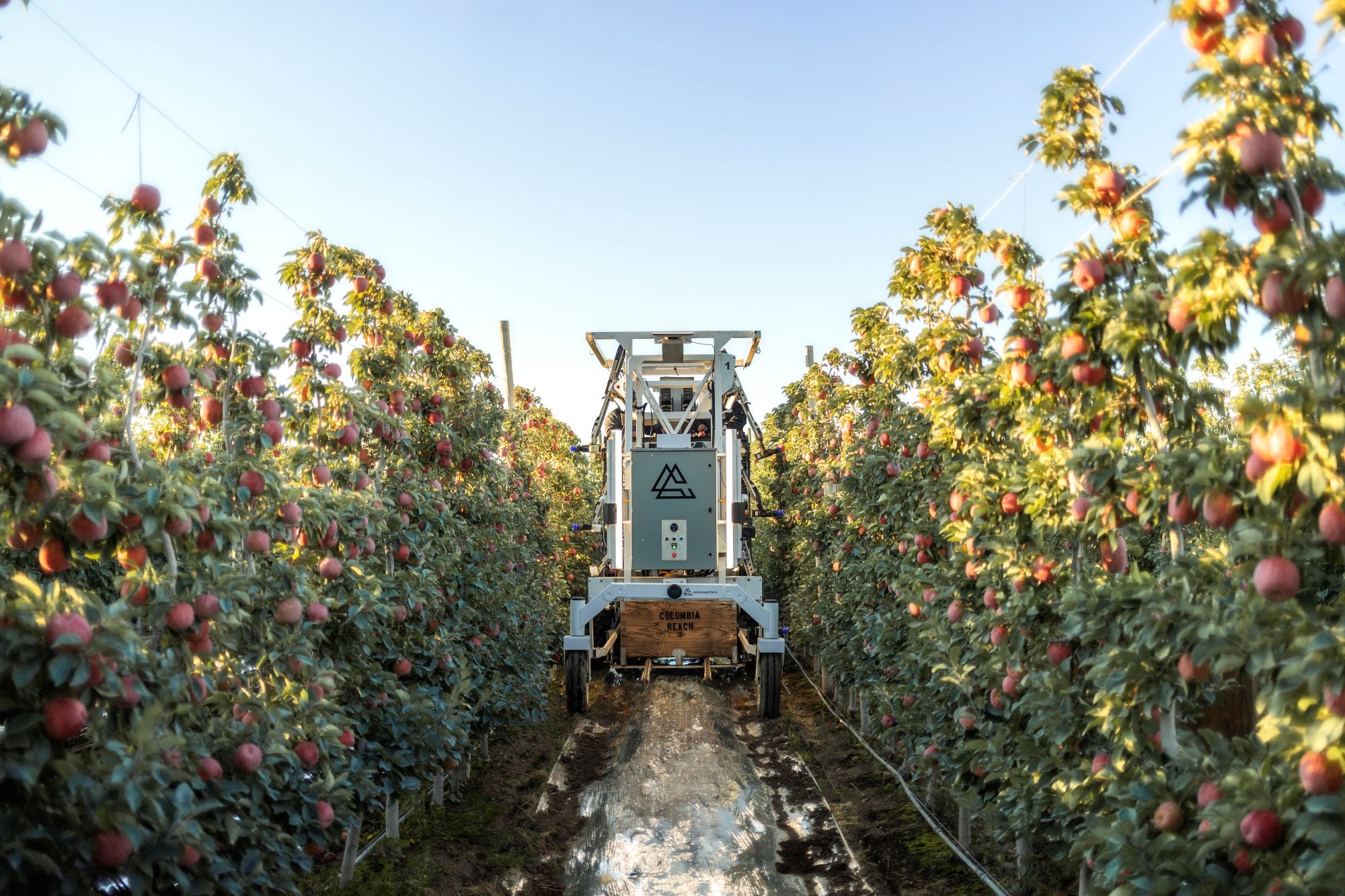
The 300,000 acres of U.S. apples employ more hand workers than any other commodity, and the 50,000 acres of strawberries are the most labor-intensive major commodity. Farmers are planting apple orchards with dwarf trees whose limbs are trained to create fruiting walls, making the apples easier for machines or workers to pick.
The cost of robots is decreasing while the cost of labor is increasing, meaning there is an X-crossover when robots are cheaper than people. Robot makers have been too optimistic that machine costs will fall and labor costs rise; the X-point in apples is now expected in the early 2030s. Once that crossover point is reached, adoption tends to accelerate in the steep portion of an S-pattern rather than move incrementally. The issue is not whether robots will arrive, but when robots cross the X economic threshold in crops such as apples and strawberries.
Picking strawberries by machine is hard because the same plant may be picked 30 or 40 times over the season. Robots can detect and pick 50 to 70% of ripe strawberries early in the season when canopies are less dense, but their efficiency decreases as plants grow. Robots pick strawberries into bulk field bins rather than directly into retail clamshell containers, meaning the fruit must later be transferred and packed in a shed.
Robots today pick apples, strawberries, and other commodities, but their widespread adoption requires a combination of lower costs and improved efficiency (detecting ripe produce) and faster speeds (humans pick an apple or strawberry in about 2 seconds). Farmers must adapt new farming systems to use robots efficiently, and they will be more motivated to do so if labor costs continue to rise.
Where does the U.S. stand in 2026? The Trump administration reduced the effective cost of migrant H-2A workers by 15–25% between 2025 and 2026, primarily by revising the methodology for calculating the Adverse Effect Wage Rate (AEWR); Trump also increased uncertainty about free trade with “Made in America” policies. University and venture-funded robot research continues, but the urgency of finding robot breakthroughs seems diminished for financially stressed farmers.
There is general agreement that robots in the fields are coming, but the timing depends on when labor costs, machine efficiency, and farm systems align. In apples, that crossover may be roughly five years away. In strawberries, the wait is likely longer. When the X-point arrives, adoption could move far faster than many expect.