Apples today are surely the produce category we take for granted. A part of everyday U.S. life since European colonists first brought them to North America, it can be easy to forget — and even easier not to realize — that apples originate not from Europe or the Americas, but from Kazakhstan in Central Asia.
While the first apples were brought to Europe in 1500 B.C., the crop began to evolve when the Ancient Greeks first employed grafting around 800 B.C. Centuries later, grafting and varietal development still form the core of a North American industry that is today valued at $23 billion, according to the U.S. Apple Association.
Still the No. 1 most-consumed fruit in the country, around 11.1 billion pounds of apples are grown in the United States every year by an estimated 27,000 producers across 50 states.
But what is it that makes apples special within the produce business as a whole, and what are the key elements to the category’s enduring success?
A Variety for Everyone
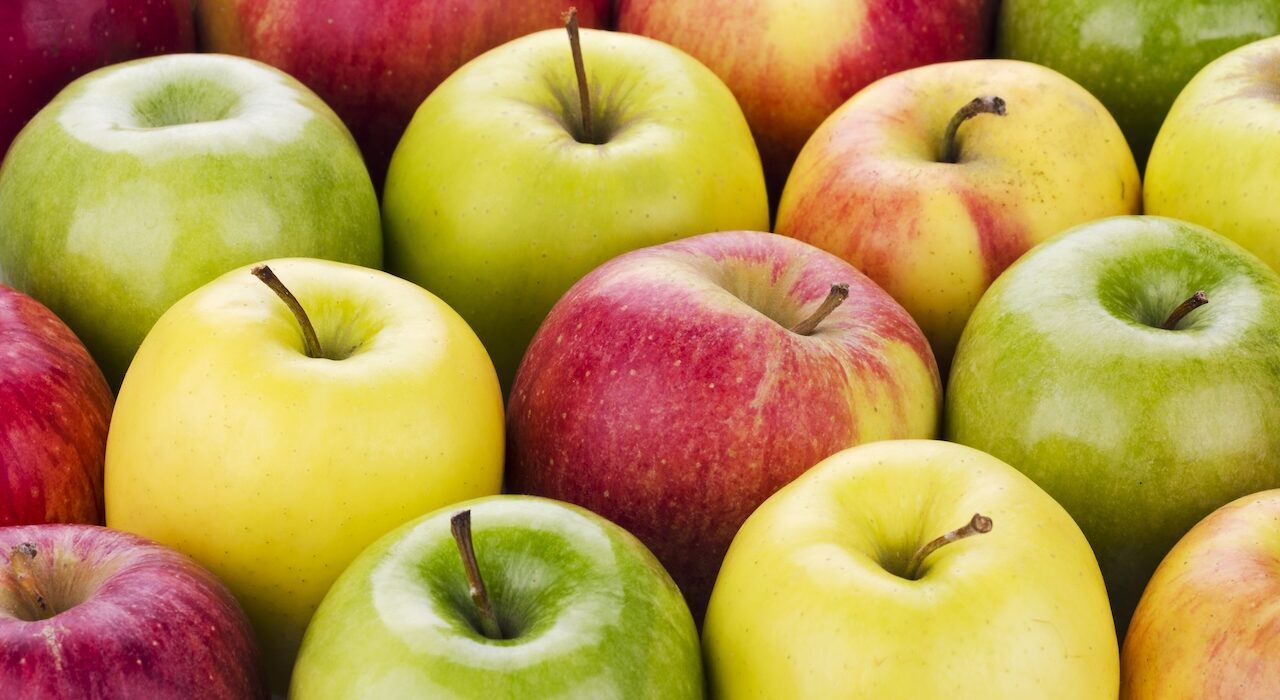
Wenatchee, WA-based Stemilt Growers is able to trace its history back to 1914, when its first apple orchard was planted on Stemilt Hill in the city. Today, the company’s apple mix includes core varieties such as Honeycrisp, Gala, Pink Lady, Fuji, Granny Smith, and Red and Golden Delicious, club apples including Cosmic Crisp and SweeTango, and its own Rave and Aura proprietary brands.
“Apples check a lot of boxes when it comes to flavor, quality, storage, and convenience,” says Stemilt’s marketing director, Brianna Shales. “For retailers, they are a year-round item with consistent supply and make 5% of total produce department dollars on an average annual basis, with elevated performance in the late fall and winter months (5.7%).
“Promotion opportunities on apples and a wide range of varieties, packages and organic/conventional growing types make apples a large and adaptable category for the department.
“For the consumer, it’s one of those household staple fruits that can stay in the fridge for longer amounts of time while still holding its quality and flavor. They’re also a great grab-and-go snack that’s packed with healthy vitamins and minerals. Today, there’s an apple variety for everyone, whether they’re looking for something sweet, tart, or something brand new.”
As with Stemilt, the history of Yakima, WA-headquartered Superfresh Growers can be traced back a considerable length of time — in this case, 150 years. Current chief executive, Robert Kershaw, heads the sixth generation of the founding Kershaw family to run the company, continuing to oversee a business that includes Superfresh’s own orchards and those of grower partners across the Pacific Northwest.
With their own protective skin and no need for packaging, apples are nature’s perfect grab-and-go snack, according to Superfresh’s director of marketing, Catherine Gipe-Stewart. “Just toss one in a backpack, lunchbox, or gym bag and you’re set,” she says. “They’re sturdy enough to handle the journey, easy to eat anywhere, and leave nothing behind but a core.”
Beyond convenience, Gipe-Stewart points out that apples are packed with fiber, vitamin C, and antioxidants, making them a smart choice for sustained energy and overall wellness. “Fresh, crisp, and naturally portable, they’re proof that the best packaging comes from nature itself,” she adds.
Category Evolution
Based in Gardners, PA, Rice Fruit Company is a family-run business that has been growing, packing, and marketing apples since 1913, most of which are sold along the length of the U.S. East Coast.
“For me, I think the difference between apples and other categories is that there is a flavor profile for every preference — across all taste profiles, you can find something for every taste, which is very unique,” says Valerie Ramsburg, content marketing manager at Rice Fruit. “I think that’s what sets our industry apart.”
But while there were just a handful of apple varieties in large volumes a few short decades ago, new varieties have come increasingly to the fore over recent years.
Ramsburg attributes this evolution to the commercialization of the Honeycrisp. “The Honeycrisp emerged commercially in 1997 and that changed the apple category forever because people went absolutely wild for this apple — nothing had ever been developed like that before,” she recalls.
After Honeycrisp’s commercial debut, Ramsburg says growers were motivated to find new varieties offering a similar, positive eating experience. From a production standpoint, she emphasizes the importance of having new varieties that are “growable, storable, and marketable, all throughout the season,” she says, adding, “There are a bunch of different elements that need to come together as a part of varietal development.”
But while Shales at Stemilt agrees the introduction of new varieties has improved the overall flavor experience, she predicts industry supply will need to settle on fewer apples to ensure future consumer demand and purchasing habits are met.
Shales says the industry has seen shifts in supply over the past two years with Cosmic Crisp and Pink Lady capturing a higher percentage of apple volume and dollars in 2024/25. She says this was largely the result of a shorter crop of consumer favorite Honeycrisp, adding she expects volumes to recover during 2025.
“It’s been challenging in apples as many outside factors such as labor and input cost inflation, tariffs and weather have combined to put downward pressure on recent crops,” admits Shales. “We are in a period of change in apples as supply exceeds current demand and that will need correction, while we also focus as an industry on increasing apple consumption, especially in the U.S. where it is not growing.”
In the case of Superfresh, Gipe-Stewart says the company has significantly grown its supply of Cosmic Crisp, both conventional and organic, during the past five years, with conventional tonnage up by 63% and organic by 147%.
“Cosmic Crisp volumes have risen steadily each year as planted trees have matured,” she says. “Organic production saw an especially large jump from 2022 to 2023, up 143%, followed by continued growth the next year before leveling off for the 2024 and 2025 crops.”
Similar dramatic growth has been seen with Superfresh’s Pink Lady volumes, with conventional increasing by 98% from 2022 to the 2025 forecast, while organic grew by 142% over the same period.
Jen Lessner, senior manager, shopper marketing & insights at the North American division of T&G Global, says the apple category has struggled of late, with lower volumes and flat sales.
She also singles out the impact of the smaller Honeycrisp crop — still the No. 1 apple in the U.S. — on the category as a whole. “Total apple volume might be up just a smidge, but with volume being down double digits for Honeycrisp, it’s driving down the whole category results,” says Lessner.
Conversely, with a larger crop of T&G’s own Envy brand, the company embarked on a large-scale promotional campaign, all the while maintaining Envy’s premium price. The result was a close to 50% increase in volume sales in July 2025 alone.
“As a brand, we are trying to elevate the perception consumers have of apples because right now they are wrongly viewed as commodities,” notes Lessner.
“There are about 15 or 16 different varietals of apples, and it’s hard for consumers when they go into a store and they really don’t know the difference — that’s something we’re trying to change. We’re trying to elevate the perception of Envy as an apple brand.”
With budget-conscious consumers increasingly buying based on price, Lessner says premium brands are focusing on a more select group of shoppers. As an example, she cites the fact that T&G’s top U.S. retail customer only stocks four varieties, including Envy. “Consumers are grabbing Envy because we do sampling in the stores, and we try to stay front and center,” says Lessner.
“We’re trying to hold that premium pricing as best we can because we want to make sure our returns to the growers are always really positive,” she adds. “But also we’re driving it from a brand perspective. We really want to be known as the premium apple brand that consumers purchase on a regular basis.”
Sustainable Convenience
Over the past two years, sustainability has been a big focus in the retail space and for growers, according to Shales. In response, Stemilt has developed a four-pack of organic apples packaged in paperboard, which Shales says will help retailers capture organic rings at the register and serve the consumer who is looking for environmentally sustainable packaging.
Another important trend to look out for, she continues, is how demand for convenience can dovetail with increased consumer interest in healthy eating. “When it comes to convenience, consumers are living busy lives but still want to prioritize healthy eating, and apples can absolutely fit into that need,” says Shales. “We’ve seen an increase in demand for bagged apples that are easy to pick up from the shelf and place in the cart.”
Tying into both trends is the growth of apples as part of midday meals, according to Gipe-Stewart. “Nearly one in three households are packing homemade lunches, and they are hungry for both value and convenience,” she says.
Gipe-Stewart notes U.S. shoppers are increasingly clear about what they want from these meals — items that require minimum preparation, foods that help balance out a full meal, and fresh over processed options. “Apples are a perfect fit for this trend: crisp, portable, and ready to eat — they deliver great taste with zero prep, making them an easy go-to for busy people packing lunches,” she adds.
Two key factors that could negatively affect the category in the coming months are trade policy changes and labor availability, according to Gipe-Stewart, who highlights uncertainty over whether tariff negotiations will include apples.
Labor availability also remains a major concern, especially as the industry enters the apple and pear harvest. “In regions with reduced domestic labor availability, the H-2A program is essential for ensuring an uninterrupted harvest,” explains Gipe-Stewart.
“Across the industry, there have been reports of delays in H-2A worker arrivals due to extended border processing times, sometimes up to three weeks, which can disrupt harvest schedules for crops like cherries that have a narrow picking window.”
“Labor is a huge concern,” acknowledges Ramsburg. “Picking apples is a skill that needs to be honed and refined. You want those experienced, seasoned pickers. There is a skill level people don’t understand, so it’s a concern getting enough people to get the crop off the trees.
“There’s not a lot of margin to work with when you are working with food. There’s a big expense getting it from the farm to your table, and we need to allocate those expenses to remain in business year after year, and that’s a challenge.”
The Importance of Branding
One area that is becoming increasingly critical to apple marketers is the role of branding, and especially for proprietary varieties, according to Gipe-Stewart. “With so many options available to consumers, a strong brand helps clearly communicate what makes a particular apple stand out — its flavor, story, and seasonal appeal,” she says.
Superfresh has spent years developing proprietary varieties such as Autumn Glory, Gipe-Stewart notes, explaining that the apple brand has resonated with younger consumers thanks to engaging storytelling, strong branding, and an emphasis on its unique flavor profile.
“With the amount of apple varieties there are today, it’s easy for an apple to become a commodity without proper branding and differentiation,” says Shales.
While she admits it can be a challenge adding branding to a PLU sticker, she says the use of a brand with a high-flavor, proprietary apple can drive repeat consumption.
“We must continue educating consumers via the point-of-sale about the unique difference a branded apple brings so that the consumer is compelled to try it,” continues Shales.
“Then, we have to deliver on the eating experience to bring repeat purchases. Consumers have so many messages thrown at them, and when it comes to grocery shopping for an apple, we have to deliver on the brand promise and much of that has to do with delivering the best product.”
Merchandising Tips
When it comes to merchandising, Shales says Stemilt targets approaches based on the retailers’ strategies for apples, seasonal promotions and goals.
“We offer many different merchandising materials for in-store activations. We’re always happy to help retailers build displays that “wow” with display-ready boxes, bins, bags, and signage,” she says.
“Helping connect shoppers to simple messages and understand more about the fruit, such as who grew it, and how they can use it at home are all ways to keep apples going into people’s carts. If we can help our retail partners win at the point of sale, it’s a win-win for everyone.”
Although Rice Fruit isn’t directly involved in merchandising at a store level, Ramsburg says the company always makes sure its packaging is engaging and eye-catching with a view to attracting shoppers. “We can’t control what happens at a store level, but we can control our packaging, so we want to make sure it’s bright, colorful and it catches consumers’ eyes from across the aisle,” she says.
Ramsburg also recommends incorporating apples in end caps to highlight their complementary flavor profile with items such as savory cheese.
Superfresh supports retail customers with custom merchandising props and signage tailored to each retailer’s needs, drawing on its own in-house marketing team. This flexibility, Gipe-Stewart says, allows the company to deliver impactful, brand-forward displays that engage shoppers and help drive sales.
“Shoppers who prioritize quality and premium products over price sensitivity respond strongly to merchandising that highlights an apple’s unique flavor and brand personality,” she says. “While pricing plays a role, storytelling and brand engagement have proven to be key drivers in building meaningful connections with this audience.”
However, while progress has undoubtedly been made to more effectively merchandise and brand apples, Ramsburg says there is still plenty of potential to be realized in the category.
Furthermore, when you compare the 16 pounds of apples eaten by the average U.S. consumer compared with 33 pounds for a European, it’s clear there is work to be done. This is where ‘Eat More Apples’ comes in, an industry-run initiative developed across 10 apple-growing states, which has the goal of increasing consumption.
“Everyone knows the expression, ‘An apple a day keeps the doctor away,’ but does anyone have a good understanding of why we even say this anymore?” Ramsburg says.
“The initiative will tell that story and connect with consumers. Apples are a powerhouse of nutrition, and people just forget that. The nutrition you can get from a single piece of fruit is impressive, so the initiative is going to be about communicating to consumers on the benefits of why we should eat more apples.”